





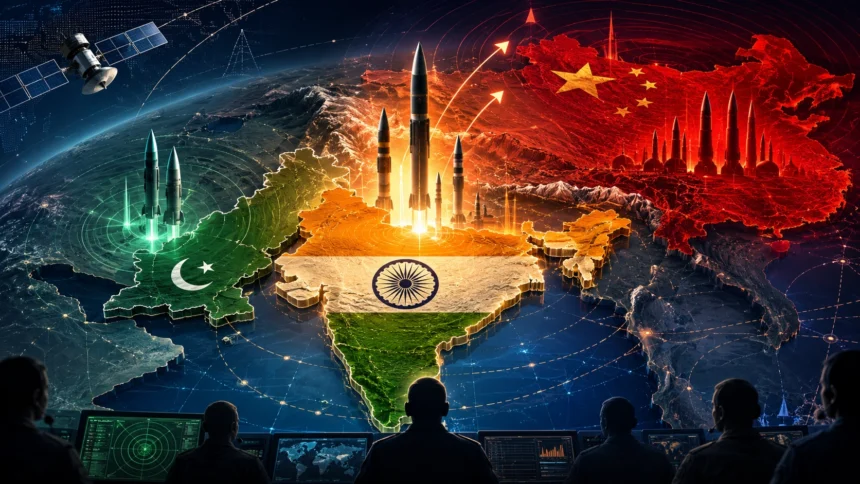
India nuclear weapons rise to 190, says SIPRI. But Pakistan is only one part of a bigger China-led security puzzle.
- SIPRI Nuclear Report: India, Pakistan And China
- Quick Fact Box
- What Happened?
- Why India Nuclear Weapons Matter Now
- Bigger Background: Pakistan Was The Old Lens
- Impact On India: More Than Just Counting Warheads
- Why China Changes The Equation
- What About Pakistan?
- The Global Warning Nobody Should Ignore
- What To Watch Next
- Nokjhok Take
- More Stories, You’ll Like
- FAQs
- 1. How many India nuclear weapons are estimated in 2026?
- 2. Does India have more nuclear weapons than Pakistan?
- 3. How many nuclear weapons does China have?
- 4. Why are India nuclear weapons important?
- 5. Is China expanding its nuclear arsenal?
- 6. Does a higher nuclear count mean more safety?
- 7. What is SIPRI?
- Comment your take:
SIPRI Nuclear Report: India, Pakistan And China
The nuclear scorecard is out, and no, this is not the kind of leaderboard anyone should celebrate with confetti.
According to the SIPRI Yearbook 2026, India is estimated to have 190 nuclear warheads, Pakistan around 170, and China around 620. SIPRI’s official release says China is expanding its nuclear arsenal faster than any other country, while India has again slightly expanded its arsenal and is developing newer delivery systems. (SIPRI)
So yes, India has moved ahead of Pakistan in estimated nuclear warheads. But the twist is this: the real strategic question is not only “India vs Pakistan.” It is increasingly “India, Pakistan, China, and a world where arms control is looking tired.”
One punchy truth: Nuclear numbers are not cricket scores; nobody wins by simply having more.
Quick Fact Box
| Point | Details |
|---|---|
| What happened | SIPRI Yearbook 2026 estimated India’s nuclear arsenal at 190 warheads. |
| Who is involved | India, Pakistan, China, Russia, USA and other nuclear-armed states. |
| Why it matters | It shows India’s nuclear posture is increasingly shaped by China, not only Pakistan. |
| Current status | India is estimated ahead of Pakistan but far behind China in warhead count. |
| One surprising detail | SIPRI estimates China has around 620 warheads and may have at least as many ICBMs as Russia or the USA by around 2030, depending on force structure. (SIPRI) |
What Happened?
SIPRI’s latest assessment says the world’s nine nuclear-armed states together possessed approximately 12,187 nuclear weapons at the start of 2026. Out of these, about 9,745 were in military stockpiles and considered potentially available for use. (SIPRI)
For India, the estimate stands at 190 nuclear warheads. Pakistan is estimated at 170. China is estimated at 620. Russia and the United States remain far ahead, with SIPRI’s table listing Russia at 5,420 and the USA at 5,042 total inventory. (SIPRI)
That means India has a small estimated lead over Pakistan. But China’s number is more than three times India’s.
This is where the headline becomes interesting.
If you only read “India ahead of Pakistan,” you get one story.
If you read “China at 620 and expanding fast,” you get the real movie.
Why India Nuclear Weapons Matter Now
India’s nuclear weapons matter because India lives in one of the world’s most complex security neighbourhoods.
On one side is Pakistan, a long-standing rival with its own nuclear arsenal. On the other side is China, a much larger military and economic power that is rapidly modernising its nuclear force.
This is not a simple neighbourhood watch group. This is geopolitics with missiles, mountains, oceans and very serious paperwork.
SIPRI says India continued developing new types of nuclear delivery systems and that its modernisation programme is increasingly focused on long-range weapons capable of reaching targets throughout China, while Pakistan remains part of India’s strategic planning. (SIPRI)
Most people are missing one point: India’s nuclear conversation is no longer only about matching Pakistan.
It is about maintaining credible deterrence in a two-front strategic environment.
Bigger Background: Pakistan Was The Old Lens
For decades, Indian public debate often viewed nuclear weapons through the India-Pakistan lens.
That was understandable.
The two countries have fought wars, faced military crises, and built security doctrines around each other. Pakistan’s nuclear posture has also been central to South Asian strategic stability.
But the security map has changed.
China is now the bigger strategic variable. SIPRI says China’s nuclear arsenal increased from about 600 to up to 620 warheads during the year, and it is in the middle of a significant modernisation and expansion programme. (SIPRI)
Here’s the interesting part: SIPRI also says China had loaded hundreds of missiles into three large missile silo fields by January 2026 and was working on more silo facilities. (SIPRI)
That does not mean war is coming. It means deterrence planning is getting more complicated.
And in defence strategy, complicated is never cheap.
Impact On India: More Than Just Counting Warheads
A nuclear arsenal is not only about the number of warheads.
It is also about delivery systems, survivability, command structure, submarine capability, missile range, readiness, doctrine and credibility.
In simple English, it is not just “how many.” It is also “can they survive, can they reach, can they deter, and can escalation be controlled?”
This sounds simple, but it is not.
A country may have fewer warheads but still maintain strong deterrence if its systems are survivable and credible. Another country may have more warheads but still face strategic uncertainty.
For India, the big issue is balance.
India has to deter Pakistan without triggering needless escalation. It also has to prepare for a larger China challenge without entering a reckless arms race.
That is like driving on a mountain road while two trucks are coming from different directions and your relatives are still asking, “When will we reach?”
Why China Changes The Equation
China is the real strategic headline here.
SIPRI states that China is expanding faster than any other nuclear-armed country. It also says that depending on how China structures its forces, it could have at least as many ICBMs as either Russia or the USA by the end of the decade. (SIPRI)
That is a major signal.
For India, China’s growth means three things.
First, India’s long-range missile development becomes more important.
Second, sea-based deterrence becomes more relevant because submarines can improve survivability.
Third, nuclear diplomacy and crisis management become even more necessary.
A larger arsenal does not automatically make a country safer. Sometimes it just makes the room more nervous.
What About Pakistan?
Pakistan remains important.
SIPRI says Pakistan continued to develop new delivery systems and accumulate fissile material in 2025, suggesting that its arsenal may expand over the coming decade. (SIPRI)
The SIPRI summary lists Pakistan at 170 nuclear warheads, unchanged in comparison with some recent media-reported estimates. (SIPRI)
So India may have a small numerical edge. But nuclear strategy does not work like a school exam where 190 beats 170 and everyone claps.
Even smaller arsenals can create serious deterrence risks.
In nuclear matters, “slightly ahead” does not mean “problem solved.”
It means the region remains sensitive.
The Global Warning Nobody Should Ignore
The bigger warning is global.
SIPRI says the number of nuclear warheads in the world continues to decline overall, but mainly because the USA and Russia are dismantling retired warheads. The report warns that the pace of dismantling appears to be slowing, while new warheads may soon enter global stockpiles faster than old ones are removed. (SIPRI)
Translation: the world is not exactly walking confidently toward disarmament.
It is walking, checking its phone, near a cliff.
Arms control agreements are under pressure. Transparency is falling. Countries are modernising. Doctrines are changing.
This is why the SIPRI report matters.
It is not just about India beating Pakistan by 20.
It is about a world where nuclear weapons are again becoming central to power politics.
What To Watch Next
Watch three things.
First, China’s nuclear expansion. If China continues growing and modernising, India’s security planners will keep adjusting.
Second, India’s delivery systems. Long-range missiles, submarine-based deterrence and survivability will remain key words.
Third, global arms control. If major powers stop cooperating, smaller and regional powers may also feel pressure to modernise faster.
The real concern is not one year’s increase.
The real concern is the direction of travel.
If everyone feels insecure and everyone builds more, the world does not become safer. It becomes louder, costlier and more fragile.
Nokjhok Take
The SIPRI report is not a patriotic scoreboard. It is a strategic warning label.
Yes, India is estimated to be ahead of Pakistan in nuclear warheads. But the bigger message is that China is far ahead and expanding fast.
So the story is not “India has more than Pakistan, party time.”
The story is: India is trying to maintain credible deterrence in a tougher neighbourhood while the world’s nuclear powers are quietly polishing their arsenals.
Basically, this is not just defence news. This is geopolitics with a calculator and a very serious face.
Final one-liner: In nuclear strategy, being ahead is less important than keeping the peace behind.
More Stories, You’ll Like
- India-China Border Tensions Explained Without Boring You
- Nuclear Deterrence Explained: Why Countries Build Weapons They Hope Never To Use
- Air Raid Warning System: India’s New Safety Net

FAQs
1. How many India nuclear weapons are estimated in 2026?
SIPRI estimates India has around 190 nuclear warheads as of January 2026.
2. Does India have more nuclear weapons than Pakistan?
Yes. SIPRI estimates India has around 190 nuclear warheads, while Pakistan has around 170.
3. How many nuclear weapons does China have?
SIPRI estimates China has around 620 nuclear warheads as of January 2026.
4. Why are India nuclear weapons important?
India nuclear weapons are important for deterrence, especially because India faces security concerns involving both Pakistan and China.
5. Is China expanding its nuclear arsenal?
Yes. SIPRI says China is expanding its nuclear arsenal faster than any other country.
6. Does a higher nuclear count mean more safety?
Not necessarily. Nuclear security depends on deterrence, survivability, doctrine, command systems and crisis control, not just numbers.
7. What is SIPRI?
SIPRI is the Stockholm International Peace Research Institute, an independent institute that researches conflict, armaments, arms control and disarmament.
Comment your take:
Is India’s nuclear challenge still mainly about Pakistan, or has China changed the whole game? Share this before your WhatsApp group converts a serious SIPRI report into a patriotic cricket scorecard.
Source reference: SIPRI Yearbook 2026, SIPRI official press release, News18.