




Bengal cabinet decisions bring ₹3000 aid, free bus travel and 7th Pay Commission buzz. Here’s who gains and what changes.
- Bengal Cabinet Decisions: Welfare Express Has Arrived
- Quick Fact Box
- What Happened?
- Why Middle-Class Readers Should Care
- Bengal Cabinet And The ₹3,000 Annapurna Scheme
- Scam Warning: Fake Annapurna Links May Appear
- Free Bus Travel For Women: Small Ticket, Big Relief
- 7th Pay Commission: Big Hope For Employees
- Ending Religious-Category-Based Assistance
- Impact On Household Budget
- Impact On State Finances
- What Readers Should Do Now
- What To Watch Next
- Nokjhok Take
- Read These Too
- FAQs
- 1. What did the Bengal cabinet approve?
- 2. What is the Annapurna scheme in Bengal?
- 3. When will women get free bus travel in Bengal?
- 4. Who will get ₹3,000 under the Annapurna scheme?
- 5. What is the 7th Pay Commission decision in Bengal?
- 6. Are religious-category-based schemes being stopped?
- 7. Should people apply online for Annapurna scheme now?
- What do you think
Bengal Cabinet Decisions: Welfare Express Has Arrived
The Bengal cabinet has pressed the “big announcement” button, and this time the list is not small.
Women may get ₹3,000 monthly support.
Women may travel free in government buses.
State employees may finally see movement on the 7th Pay Commission.
And some religious-category-based assistance schemes are being stopped.
One-liner: This is not just a cabinet meeting; this is Bengal politics with budget, buses and benefits in one plate.
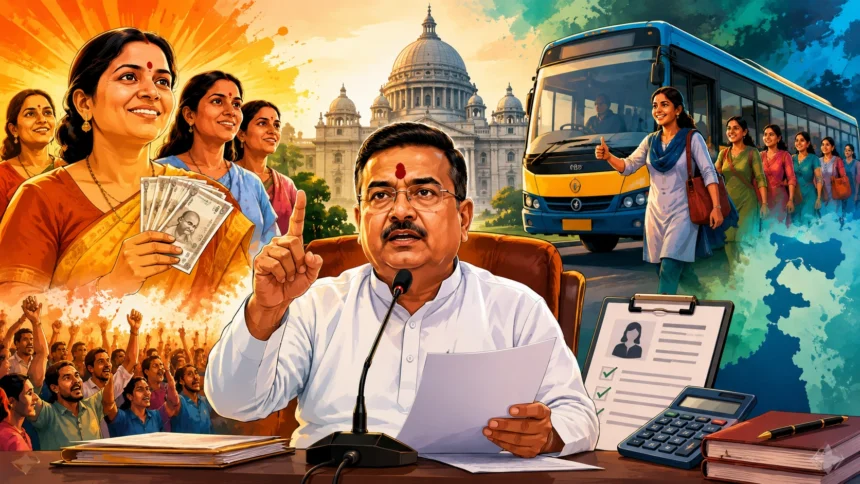
Reports say the West Bengal cabinet, led by Chief Minister Suvendu Adhikari, approved the Annapurna scheme of ₹3,000 monthly assistance for women from June 1 and also cleared free travel for women in government-run buses from the same date. The cabinet also approved steps related to the 7th Pay Commission for state employees. (Deccan Herald)
Useful external references:
Deccan Herald report on Annapurna scheme and free bus travel
ABP report on Bengal cabinet decisions
TOI report on Bengal cabinet decisions
Quick Fact Box
| Point | Simple Explanation |
|---|---|
| What happened | The Bengal cabinet approved major welfare and employee-related decisions. |
| Who is involved | West Bengal government, women beneficiaries, state employees, transport users. |
| Why it matters | These decisions can affect household income, transport cost and salary expectations. |
| Current status | Annapurna aid and free bus travel are reported to begin from June 1. |
| One surprising detail | Religious-category-based government assistance is reportedly being discontinued from June. |
What Happened?
The Bengal cabinet held its second meeting and cleared several decisions that can directly touch daily life.
The biggest headline is the Annapurna scheme. Under this, eligible women are expected to receive ₹3,000 per month. Reports say women already receiving benefits under earlier welfare support may be moved to the new scheme through direct bank transfer. (Telegraph India)
The second big move is free travel for women in government-run buses from June 1. For working women, students, domestic workers, small business owners and daily commuters, this is not a small announcement. It can reduce monthly travel expenses.
The third big decision is linked to state government employees. The cabinet reportedly approved the formation or implementation process related to the 7th Pay Commission. For employees waiting for salary revision, this is the kind of news that makes office WhatsApp groups wake up faster than morning tea. (ABP Live)
And then comes the politically sharp part: the government has reportedly decided to discontinue state assistance based on religious categorisation from June. (India Today)
So yes, one meeting. Many signals.
Why Middle-Class Readers Should Care
Because these Bengal cabinet decisions are not just “government file movement.”
They can affect money in hand, travel costs, salary hopes, political debate and future welfare design.
For women from lower-income households, ₹3,000 per month can help with groceries, medicines, children’s education, mobile recharge, transport or small personal savings.
For women commuters, free bus travel can reduce monthly pressure.
For state employees, the 7th Pay Commission issue is about salary, dignity, arrears, DA gap and long-pending expectations.
For taxpayers and voters, the big question is: how will the state fund all this?
Because welfare announcements are like wedding buffets. Everyone is happy at the counter. But someone has to pay the catering bill.
Bengal Cabinet And The ₹3,000 Annapurna Scheme
The Annapurna scheme is clearly the emotional headline of the package.
Reports say the scheme will provide ₹3,000 monthly assistance to women from June 1. State minister Agnimitra Paul said the cabinet gave its nod to the scheme, and women covered earlier under Lakshmi Bhandar would be shifted under Annapurna Bhandar through direct bank transfer. (Deccan Herald)
This sounds simple, but there are three important points.
First, the amount is politically powerful. ₹3,000 per month is ₹36,000 per year. For many households, that is not pocket money. That is survival support.
Second, direct bank transfer reduces middleman drama. If implemented properly, money goes directly to the beneficiary’s bank account.
Third, eligibility rules will matter. Who gets it? Who is excluded? What documents are needed? Will previous beneficiaries automatically shift? Will new applicants get a portal or camp-based system?
Most people are missing this point: announcement is one thing, implementation is the real test.
Scam Warning: Fake Annapurna Links May Appear
Here’s the interesting part.
Whenever a new welfare scheme is announced, scammers also wake up.
Times of India reported that police had warned people about fake websites and online scams misusing the Annapurna Bhandar scheme name. The warning said citizens should avoid sharing OTPs, bank details or personal information on suspicious sites. (The Times of India)
This is important.
If you see a random link saying “Apply now and get ₹3,000 instantly,” do not become emotional.
Government schemes do not usually arrive through suspicious WhatsApp forwards with broken English and urgent countdown timers.
Check official sources. Wait for verified portals or government camps. Never share OTP. Never pay “processing fee.” Never upload documents on unknown websites.
In short: scheme ka benefit lena hai, scam ka nahi.
Free Bus Travel For Women: Small Ticket, Big Relief
The Bengal cabinet also approved free travel for women in government-run buses from June 1, according to reports. (Deccan Herald)
This can matter a lot.
A student travelling daily.
A nurse working shifts.
A teacher commuting to school.
A domestic worker going from one locality to another.
A woman visiting hospital or government office.
For each of them, free bus travel can reduce monthly pressure.
But the twist is: transport schemes need strong execution.
Will bus frequency increase?
Will buses become overcrowded?
Will women feel safe?
Will the state compensate transport corporations properly?
Will private operators complain?
Will rural routes get enough coverage?
A free ride is useful only when the bus actually arrives.
Otherwise, it becomes a policy poster with no wheels.
7th Pay Commission: Big Hope For Employees
Now let us talk about the government employee angle.
The cabinet reportedly approved steps toward the 7th Pay Commission for state government employees, aided educational institutions and related bodies. Reports earlier noted that DA revision and pay commission implementation were major agenda points. (The Times of India)
For employees, this is not just a salary matter. It is about long-pending parity concerns.
Many state employees have argued for better pay alignment with central government structures. DA gaps and arrears have also been serious issues in Bengal’s employee politics.
If implemented, this can increase income for many families.
But again, budget enters the room wearing serious glasses.
Salary revision means higher government expenditure. Pension impact may also follow. Arrears, if included, can create a large fiscal burden.
So employees will ask: “When will we get it?”
The finance department will ask: “How much will it cost?”
And the common taxpayer will ask: “Will this affect other services?”
Democracy, basically, is everyone asking different questions at the same time.
Ending Religious-Category-Based Assistance
Another important decision is the reported discontinuation of government assistance based on religious lines from June.
Reports say the government will stop some assistance schemes linked to religious categorisation, while scholarships or programmes under some departments may continue only for the current month before being stopped from June. (India Today)
This decision will naturally create political debate.
Supporters may say welfare should be based on economic need, not religious identity.
Critics may ask whether vulnerable groups will lose support and whether the replacement system will protect genuine beneficiaries.
The real issue is design.
If the state shifts from religion-based schemes to income-based, education-based, disability-based, women-focused or poverty-focused schemes, the impact will depend on how fairly and efficiently eligibility is decided.
In simple words, removing categories is one thing. Protecting the needy is another.
Policy must not become a slogan. It must become a working system.
Impact On Household Budget
For a woman beneficiary, ₹3,000 per month can be meaningful.
Let us take a simple example.
₹1,200 for groceries.
₹500 for medicines.
₹400 for mobile and utilities.
₹500 for children’s school needs.
₹400 saved for emergencies.
This is not luxury. This is daily life.
Now add free bus travel. If a woman spends ₹30–₹50 daily on travel, monthly savings can be significant.
So from a household level, the combination of cash support and free transport can create real relief.
But welfare should not stop at money transfer. The government must ensure easy application, low paperwork, safe buses, clear eligibility and timely payments.
Because poor implementation can turn a good scheme into a queue management disaster.
Impact On State Finances
Now the less glamorous but very important part: money.
Every welfare scheme needs funding.
₹3,000 monthly assistance to a large number of women will require a huge recurring budget. Free bus travel also requires compensation to the transport system. Pay commission implementation can sharply increase salary expenditure.
So the Bengal cabinet has made politically powerful decisions, but the fiscal planning will decide long-term success.
If revenue is strong and leakage is controlled, such schemes can work well.
But if funding is weak, delays may start. Payments may become irregular. Transport quality may suffer. Salary implementation may get stretched.
That is why citizens should watch not just announcements, but budget allocation, official guidelines, beneficiary numbers and rollout timelines.
Because in governance, headline is the trailer. Budget is the real movie.
What Readers Should Do Now
Do not panic. Do not rush to fake websites.
Women who may be eligible for the Annapurna scheme should wait for official instructions from the state government, local offices, verified portals or government camps.
Keep basic documents ready: Aadhaar, voter ID, bank account details, ration card if required, residence proof and mobile number linked to bank account where applicable.
Women planning to use free bus travel should watch for official transport department guidelines from June 1.
State employees should wait for formal notification on the 7th Pay Commission process, eligibility, implementation date and arrears position.
And everyone should avoid WhatsApp rumours. They are free, but the confusion is costly.
What To Watch Next
Watch five things closely.
First, official guidelines for Annapurna scheme eligibility.
Second, how previous Lakshmi Bhandar beneficiaries are shifted.
Third, whether free bus travel applies to all government buses or selected categories.
Fourth, the structure and timeline of the 7th Pay Commission process.
Fifth, how the government replaces or redesigns religious-category-based assistance.
The next few weeks will decide whether this becomes a smooth welfare rollout or another “server down, document missing, come tomorrow” story.
Nokjhok Take
The Bengal cabinet has delivered a package that mixes welfare, women-focused benefits, employee expectations and political messaging.
₹3,000 for women can help households.
Free bus travel can support mobility.
7th Pay Commission movement can please employees.
Stopping religious-category-based schemes can reshape welfare politics.
But here is the real test: implementation.
If the money reaches on time, buses run properly, employees get clear rules, and genuine beneficiaries are protected, this can become a strong governance story.
If not, it may become another file-heavy scheme where citizens run from counter to counter while leaders cut ribbons.
Basically, this is not just a cabinet decision. This is Bengal’s welfare exam — and the answer sheet will be checked by voters.
Read These Too
- Welfare Schemes Explained: Free Money Or Smart Support?
- Direct Benefit Transfer Explained Without Boring You
- Bengal News Today: BJP Rule Sparks Fast Changes

FAQs
1. What did the Bengal cabinet approve?
The Bengal cabinet approved ₹3,000 monthly assistance for women, free bus travel for women and steps related to the 7th Pay Commission.
2. What is the Annapurna scheme in Bengal?
The Annapurna scheme is a welfare plan reported to provide ₹3,000 per month to eligible women in West Bengal.
3. When will women get free bus travel in Bengal?
Reports say free travel for women in government-run buses will start from June 1.
4. Who will get ₹3,000 under the Annapurna scheme?
Detailed eligibility rules are awaited, but reports say women beneficiaries, including earlier welfare recipients, may be covered through direct bank transfer.
5. What is the 7th Pay Commission decision in Bengal?
The cabinet reportedly approved steps to implement or constitute the 7th Pay Commission process for state employees and related institutions.
6. Are religious-category-based schemes being stopped?
Reports say the Bengal government will discontinue some assistance based on religious categorisation from June.
7. Should people apply online for Annapurna scheme now?
People should wait for official government portals or verified instructions and avoid fake websites or WhatsApp links.
What do you think
— strong welfare move or big budget pressure coming soon?
Comment your view, share this with someone in Bengal, and read our next explainer before your family WhatsApp group turns this into a full cabinet debate.
Source reference: Deccan Herald, ABP Live, Times of India, Economic Times, India Today, Telegraph India.