





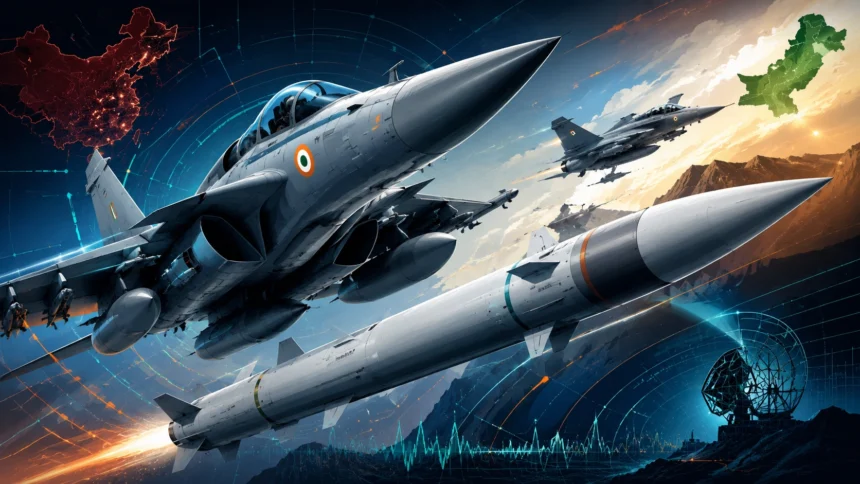
PL-15E missile recovery may give India rare clues into Chinese air-war tech. Here’s why this matters beyond headlines.
- PL-15E Missile: The Weapon That Became Homework
- Quick Fact Box
- What Happened?
- Why PL-15E Missile Matters Now
- Bigger Background: Why China-Pakistan Defence Link Matters
- Impact On Indian Air Force
- Tejas, Su-30MKI And Rafale Angle
- The Astra Mk2 Connection
- What People Are Missing
- Why The Self-Destruct Question Matters
- What To Watch Next
- Why Readers Should Care
- Nokjhok Take
- Internal Link Suggestions For Nokjhok
- FAQs
- 1. What is the PL-15E missile?
- 2. Did India recover a PL-15E missile?
- 3. Why is PL-15E missile important for India?
- 4. Which aircraft may benefit from this analysis?
- 5. Does this mean PL-15E missile is useless?
- 6. Is this officially confirmed by DRDO?
- 7. How can missile analysis help Astra Mk2?
- What do you think — is this India’s quiet defence win, or are viral defence headlines getting too excited?
PL-15E Missile: The Weapon That Became Homework
The PL-15E missile story is not just about one missile falling in Punjab.
It is about technology.
It is about air warfare.
It is about India, Pakistan and China sitting inside one defence headline.
And yes, it is also about that classic battlefield twist: sometimes the weapon you fire becomes the enemy’s study material.
One-liner: Pakistan fired the missile, but India may have got the syllabus.
Media reports claim that Indian teams recovered a near-intact Chinese-origin PL-15E air-to-air missile in Punjab during the May 2025 India-Pakistan escalation and later analysed its electronic signatures, radar seeker behaviour and communication patterns. These claims are based on media reporting; no full technical public confirmation has been issued by Indian defence authorities. (Meta-Defense.fr)
Useful external references:
Meta-Defense report on PL-15E recovery and analysis
Navbharat Times report on PL-15E decoding
EurAsian Times background on recovered PL-15E
Quick Fact Box
| Point | Simple Explanation |
|---|---|
| What happened | Reports claim India recovered and studied a Chinese-origin PL-15E missile. |
| Who is involved | India, Pakistan, China, DRDO, IAF and defence analysts. |
| Why it matters | The missile may reveal useful clues about Chinese air-to-air missile technology. |
| Current status | Reported analysis is being discussed widely, but full official technical details are not public. |
| One surprising detail | The missile was reportedly recovered in a near-intact state near Hoshiarpur, Punjab. (EURASIAN TIMES) |
What Happened?
During the India-Pakistan military escalation in May 2025, reports say Pakistan used Chinese-origin weapons, including PL-15 series air-to-air missiles. One PL-15E missile was reportedly recovered in India, near Hoshiarpur in Punjab, after travelling a long distance without self-destruction. (EURASIAN TIMES)
Now, this is where the story gets interesting.
Normally, advanced missiles are expected to either hit the target or destroy themselves if they fail. That reduces the chance of sensitive technology falling into enemy hands.
But reports say this missile was recovered in a condition good enough for technical examination. If true, that is not just debris. That is a defence lab opportunity.
Indian engineers and defence teams reportedly studied its radar seeker, electronic signals, data-link pattern and guidance behaviour. Meta-Defense claimed DRDO and IAF teams extracted the missile’s electronic signature and integrated those parameters into electronic-warfare databases. (Meta-Defense.fr)
In simple words: India may now understand the missile better than before.
And in air combat, understanding the enemy’s weapon is half the insurance policy.
Why PL-15E Missile Matters Now
The PL-15E missile matters because modern air battles are not only about fast jets and brave pilots.
They are about sensors.
Radars.
Jamming.
Data links.
Electronic signatures.
Detection range.
Countermeasures.
A missile is no longer just “rocket plus explosion.” It is a flying computer with radar, software and decision-making logic.
The PL-15E is the export version of China’s PL-15 beyond-visual-range air-to-air missile. Reports describe it as a major Chinese BVR weapon supplied to Pakistan’s fighter fleet. (EURASIAN TIMES)
That means India would naturally want to know:
How does it detect a target?
How does it resist jamming?
How does its radar seeker behave?
What signals does it emit?
How can aircraft detect it early?
How can pilots confuse it?
This sounds technical, but the impact is very practical.
A better understanding of a missile can help improve aircraft defensive systems, tactics and pilot training.
Basically, if you know the enemy’s punch style, you can train your guard better.
Bigger Background: Why China-Pakistan Defence Link Matters
Pakistan’s air force has deep defence links with China. Pakistan uses Chinese-origin platforms such as JF-17 fighters, and reports have linked PL-15 series missiles with Pakistani combat aircraft. (EURASIAN TIMES)
This matters for India because any India-Pakistan air clash is no longer just an India-Pakistan weapons comparison.
Chinese systems are also part of the equation.
That is why a recovered PL-15E missile becomes valuable. It is not merely a Pakistani battlefield object. It is also a window into Chinese defence technology supplied to Pakistan.
Here’s the interesting part: China may design the system, Pakistan may operate it, and India may now study its behaviour from battlefield recovery.
That is geopolitics with a screwdriver.
Impact On Indian Air Force
If the reported analysis is accurate, the biggest benefit will be in electronic warfare.
Electronic warfare is the invisible boxing match of air combat.
One system tries to detect.
The other tries to hide.
One radar tries to lock.
The other tries to confuse.
One missile tries to chase.
The aircraft tries to break the chase.
Reports claim that data from the PL-15E may help upgrade electronic warfare suites on Tejas Mk1A, Su-30MKI and Rafale aircraft. Meta-Defense reported that Indian teams integrated threat parameters into frontline aircraft electronic-warfare databases. (Meta-Defense.fr)
This does not mean Indian jets suddenly become invincible.
No aircraft is magic. No missile is useless. No defence system is perfect.
But it may improve the probability of detection, warning, jamming and survival.
In modern air warfare, even a few extra seconds of warning can matter.
A pilot who gets earlier warning has more options.
A system that knows the threat signature can react better.
A jammer tuned to the right signal can be more effective.
That is why defence analysts are excited.
Not because India “got a toy,” but because India may have got data.
Tejas, Su-30MKI And Rafale Angle
Several reports are linking this missile analysis to India’s fighter upgrades.
The Tejas Mk1A is expected to use modern avionics and electronic-warfare systems. The Su-30MKI fleet is also going through upgrade discussions. Rafale already has the well-known SPECTRA electronic-warfare system.
If PL-15E-related data helps improve threat libraries, then these aircraft may become better prepared against similar missiles in future conflicts. (Navbharat Times)
But let us keep one thing clear.
This does not mean “Rafale ki zarurat nahi, Tejas hi sab kar dega” in a simplistic way.
Rafale, Tejas and Su-30MKI have different roles, strengths and limitations. Defence planning is not a cricket selection debate where one viral headline removes another player.
The real point is that India’s own systems may become smarter.
And that is a serious gain.
The Astra Mk2 Connection
Reports also suggest that lessons from PL-15E analysis could support India’s indigenous missile programmes, especially Astra variants.
India has been developing the Astra family of air-to-air missiles through DRDO. Reports say the newer Astra Mk2 aims for longer range and improved performance compared to earlier versions. (Navbharat Times)
If Indian scientists understand PL-15E’s guidance, seeker design or electronic behaviour better, that knowledge may support future countermeasures and domestic missile improvements.
But again, careful wording is important.
A recovered missile does not automatically create a superior missile overnight.
Defence R&D is not Maggi noodles.
It takes testing, validation, production, integration and pilot training.
But real battlefield data can make research sharper.
That is the value.
What People Are Missing
Most people are missing one point.
This story is not only about “India decoded China missile.”
It is about how wars now produce intelligence.
Every battlefield object leaves clues.
A crashed drone.
A missile fragment.
A radar trace.
A communication signal.
A failed guidance pattern.
A recovered seeker.
All of these can become intelligence.
This is why countries are desperate to recover enemy weapons and protect their own.
Once a weapon is opened, engineers can learn how it thinks.
And when they know how it thinks, they can build ways to confuse it.
That is the real game.
Why The Self-Destruct Question Matters
One claim repeated in reports is that the recovered missile did not self-destruct after missing its target. (EURASIAN TIMES)
That is important because many advanced weapons include measures to reduce technology capture.
If a missile remains mostly intact after failure, the user loses secrecy.
For China, that can be embarrassing.
For Pakistan, that can be operationally costly.
For India, that can be useful.
Of course, the exact condition of the recovered missile and the depth of analysis are not fully public. Defence matters often remain classified.
But even partial recovery can be useful.
A damaged phone can still reveal call logs. A damaged missile can still reveal design thinking.
What To Watch Next
Watch three things.
First, whether India’s electronic-warfare upgrades are discussed more openly in coming months.
Second, whether Astra Mk2 and other indigenous missile programmes gain fresh attention.
Third, whether Pakistan or China changes operational behaviour around PL-15E use.
Also watch whether future official statements confirm, deny or simply avoid these reports.
In defence, silence is also a language.
Sometimes governments do not confirm because the information is false.
Sometimes they do not confirm because the information is too useful.
And sometimes they do not confirm because everyone already knows enough.
Why Readers Should Care
You may ask: why should a normal reader care about the PL-15E missile?
Because national security is not only fought on borders.
It is also fought in labs, factories, radar rooms, software systems and pilot training schools.
A missile recovery can influence future defence planning. It can improve aircraft warning systems. It can help domestic research. It can expose weaknesses in enemy weapons. It can also shape how future air battles are fought.
This is why one fallen missile can create a large defence discussion.
In old wars, armies captured flags.
In modern wars, they capture data.
Nokjhok Take
The PL-15E missile story is a perfect example of modern warfare.
A missile was reportedly fired. It failed to deliver the expected battlefield result. Then it possibly became a source of intelligence for the other side.
The funny-but-true angle is simple: sometimes the enemy’s premium imported weapon becomes your practical lab sample.
But the serious point is bigger.
India’s advantage will not come from shouting “decoded” on social media. It will come from quietly converting that knowledge into better radars, better jammers, better tactics and stronger indigenous weapons.
This is not just missile drama. This is air warfare becoming a software update.
Basically, the PL-15E may have missed its target, but it may have hit India’s research table perfectly.
Internal Link Suggestions For Nokjhok
- India-Pakistan Air Clash Explained: What Modern Air War Looks Like
- Missile Technology Explained: How Air-To-Air Weapons Track Targets
- Su-57 Fighter Jet: Russia’s Drone Twist For India

FAQs
1. What is the PL-15E missile?
The PL-15E missile is the export version of China’s PL-15 beyond-visual-range air-to-air missile.
2. Did India recover a PL-15E missile?
Media reports claim India recovered a near-intact PL-15E missile in Punjab during the May 2025 India-Pakistan escalation.
3. Why is PL-15E missile important for India?
It may help India understand Chinese missile technology, improve electronic warfare systems and develop better countermeasures.
4. Which aircraft may benefit from this analysis?
Reports mention Tejas Mk1A, Su-30MKI and Rafale electronic-warfare systems as possible beneficiaries of threat-data updates.
5. Does this mean PL-15E missile is useless?
No. A recovered missile does not make the weapon useless. It only gives the opponent valuable information about its behaviour.
6. Is this officially confirmed by DRDO?
The detailed technical claims are based on media reports. Full official technical confirmation from DRDO is not publicly available.
7. How can missile analysis help Astra Mk2?
Studying enemy missile features may help Indian teams improve domestic missile design, tactics and countermeasure planning.
What do you think — is this India’s quiet defence win, or are viral defence headlines getting too excited?
Comment your take, share this with your “defence expert” friend, and read our next explainer before your WhatsApp group turns missile science into full Bollywood dialogue.
Source reference: Navbharat Times, Meta-Defense, EurAsian Times, Defence Security Asia, IDRW, AP, The Guardian, Reuters.