




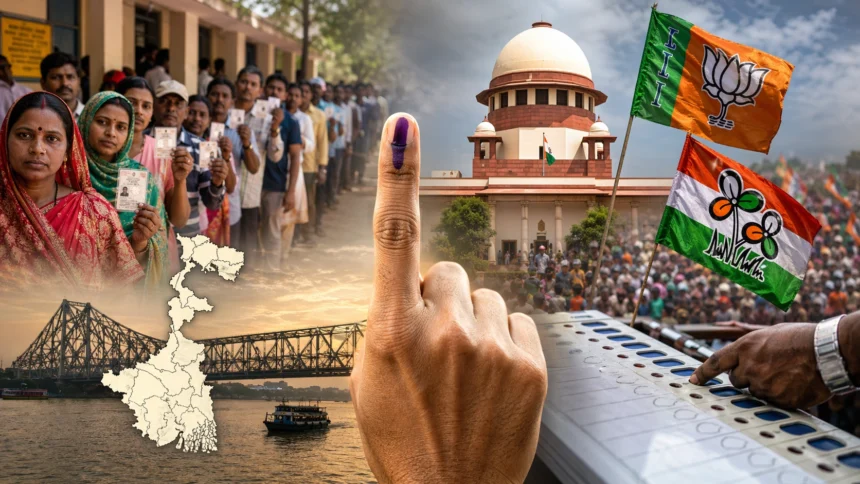
West Bengal 1st Phase Voting crossed 92%, surprising parties and even reaching Supreme Court. Here’s the real story behind it.
- Bengal Voters Just Did a Plot Twist
- What Happened in West Bengal 1st Phase Voting?
- Why CJI Surya Kant’s Reaction Became News
- What Is the SIR Issue?
- West Bengal 1st Phase Voting: Why 92% Is a Big Deal
- Peaceful Voting and Central Forces: The Quiet Hero Angle
- What BJP Is Saying After the High Turnout
- What TMC Is Saying
- The Hidden Truth: High Turnout Does Not Reveal Winner
- Why the Supreme Court Angle Makes This Story Bigger
- What Experts Are Quietly Noticing
- Final Take: Democracy Just Flexed Its Muscles
- 1. What was the West Bengal 1st Phase Voting turnout?
- 2. Why is West Bengal 1st Phase Voting important?
- 3. What did CJI Surya Kant say about Bengal voting?
- 4. What is SIR in elections?
- 5. Did central forces get praise?
- 6. Does high turnout mean BJP or TMC will win?
- 7. Why did this issue reach Supreme Court?
- What do you think—was this 92% turnout a wave of change, or Bengal voters protecting their rights?
- Suggested Related Post
Bengal Voters Just Did a Plot Twist
Something big happened in Bengal.
No, not another rally speech.
Not another “breaking news” shouting match.
This time, voters themselves became the headline.
West Bengal 1st Phase Voting crossed the 92% mark, and suddenly everyone—from political parties to the Supreme Court corridor—started looking at Bengal with raised eyebrows.
One-line truth: When voters stand in line like this, politicians stop smiling casually.
According to multiple reports, the first phase recorded over 92% turnout, with NBT reporting 92.88% and other reports placing it around 92.72% to 92.9% depending on counting updates and reporting stage. (Navbharat Times)
What Happened in West Bengal 1st Phase Voting?
The first phase of West Bengal Assembly elections became historic because voters came out in massive numbers.
Reports said polling took place across 152 constituencies in the first phase. The turnout crossed 92%, making it one of the highest voting figures seen in the state after Independence. (The Economic Times)
Now, in normal language, 92% voting means this:
Almost everyone who could vote decided, “Aaj ghar pe nahi baithna.”
This is not ordinary election enthusiasm.
This is a democratic stampede—peaceful, disciplined, and politically loaded.
And here’s the spicy part: both BJP and TMC are interpreting this high turnout in their own favour.
BJP says it is a wave of change.
TMC says it is voter alertness and anger against voter-list issues.
Same data. Two political chutneys.
Why CJI Surya Kant’s Reaction Became News
During a Supreme Court hearing related to the Special Intensive Revision (SIR) of voter lists, the issue of West Bengal’s high voter turnout came up.
Reports said Chief Justice of India Surya Kant expressed happiness over the high voter participation in the first phase. Solicitor General Tushar Mehta also reportedly praised the role of central forces in ensuring peaceful elections. (Hindustan Times)
Now, this is why the moment became interesting.
Usually, voter turnout is discussed by election analysts, news anchors, political parties, and WhatsApp uncles. But when it echoes inside the Supreme Court during an SIR-related hearing, the story gets an extra layer of seriousness.
This was not just “people voted heavily.”
This became:
“People voted heavily despite voter-list controversy, political tension, and legal battles.”
That is why this story matters.
What Is the SIR Issue?
SIR means Special Intensive Revision of electoral rolls.
In simple English, it is a deep cleaning of the voter list.
The Election Commission checks names, removes invalid entries, corrects data, and updates the roll. In theory, this improves accuracy. In practice, it often creates political fireworks.
In Bengal, SIR became controversial because many people claimed their names were deleted or excluded from voter lists. Some matters reached the Supreme Court, and reports said the court directed excluded voters to approach appellate tribunals for relief in certain cases. (www.ndtv.com)
Here’s the strange part.
Even with all this controversy, voters still came out in massive numbers.
That is why CJI Surya Kant’s reaction became a headline moment.
West Bengal 1st Phase Voting: Why 92% Is a Big Deal
A 92% turnout is not just a number.
It is a political signal.
In many elections, parties fight hard to bring voters out. Here, voters came out like they had set a group alarm.
High voting can mean many things:
1. Strong Political Awareness
People knew the election mattered.
2. Local Anger or Local Hope
High turnout can show anger against the ruling party—or strong support for it.
3. Women Voter Power
Reports around Bengal’s turnout have highlighted very high women participation in earlier turnout discussions too. In closely fought elections, women voters can quietly change the entire result.
4. Fear of Missing Out
Yes, democracy also has FOMO.
When people feel their vote may decide the future, they don’t stay home.
Peaceful Voting and Central Forces: The Quiet Hero Angle
Another important part of the story is the praise for peaceful voting.
Solicitor General Tushar Mehta reportedly appreciated the role of central forces in ensuring peaceful elections during the Supreme Court hearing. (Hindustan Times)
This matters because Bengal elections often come with concerns around violence, intimidation, booth management, and political clashes.
So when voting is high and mostly peaceful, it sends a strong message:
People felt confident enough to vote.
That is not a small thing.
In a democracy, the polling booth must feel safer than a political rally stage. Otherwise, the voter stays home and democracy becomes a VIP event.
What BJP Is Saying After the High Turnout
BJP leaders are treating the high turnout as a sign of change.
Union Home Minister Amit Shah reportedly claimed that BJP would win a big number of seats in the first phase and said people were voting for change. Reports quoted him predicting BJP’s strong performance after the record turnout. (The Times of India)
This is classic election strategy.
When turnout is high, opposition parties often say:
“People came out to remove the government.”
So BJP’s interpretation is clear:
High turnout = anti-incumbency.
But elections are not that simple.
If high turnout always meant ruling party loss, political science would be a one-page PDF.
What TMC Is Saying
TMC’s line is different.
Chief Minister Mamata Banerjee reportedly argued that the high voting reflected people’s fear and concern about losing rights due to the SIR exercise. She linked the turnout to voter awareness and resistance against alleged voter-list issues. (The Times of India)
In simple language, TMC is saying:
“People came out because they knew their vote and rights were under pressure.”
So for TMC, high turnout is not anti-incumbency.
It is mobilisation.
Again, same number. Different story.
That is Bengal politics for you: one statistic, five meanings, ten debates.
The Hidden Truth: High Turnout Does Not Reveal Winner
Most people make one mistake.
They see high turnout and instantly declare a winner.
But high turnout only tells us that people participated strongly. It does not automatically tell us who benefited.
High voting can help opposition if anger is high.
It can help ruling party if welfare schemes are working.
It can help local candidates if ground networks are strong.
It can surprise everyone if silent voters move differently.
This is why analysts are careful.
A 92% turnout is a signal.
But the result is still locked inside the EVM.
And EVMs, like Indian parents, reveal results only at the right time.
Why the Supreme Court Angle Makes This Story Bigger
The Supreme Court’s involvement through SIR-related hearings adds institutional weight to the story.
Reports said the court told excluded voters to approach tribunals for relief and also discussed the issue of out-of-turn hearings in certain cases. (Live Law)
This creates three layers:
- Election layer: People voted heavily.
- Legal layer: Voter-list issues reached court.
- Political layer: BJP and TMC are using turnout to build narratives.
That is why this is more than a voting percentage story.
It is a democracy stress-test story.
What Experts Are Quietly Noticing
Political observers are watching three things.
1. Voter Confidence
If people vote despite controversy, they are highly motivated.
2. Administrative Management
Peaceful polling with huge turnout shows strong booth-level arrangements.
3. Narrative Battle
Both BJP and TMC are already trying to own the meaning of this turnout.
Here’s the hidden warning:
The party that explains the turnout better may influence the mood before later phases.
In elections, perception travels faster than results.
Final Take: Democracy Just Flexed Its Muscles
West Bengal 1st Phase Voting has delivered a big message.
People are alert.
People are emotional.
People are participating.
Whether this helps BJP, TMC, or throws up surprises—we will know only after counting.
But for now, one thing is clear:
The voter has entered the story with full background music.
This 92% turnout is not just a statistic.
It is a democratic mic drop.
FAQs
1. What was the West Bengal 1st Phase Voting turnout?
Reports placed the turnout above 92%, with figures around 92.72% to 92.88% depending on reporting updates.
2. Why is West Bengal 1st Phase Voting important?
It is important because the turnout was historically high and became a major political and legal talking point.
3. What did CJI Surya Kant say about Bengal voting?
Reports said CJI Surya Kant expressed happiness over the high voter turnout during a Supreme Court hearing related to SIR.
4. What is SIR in elections?
SIR means Special Intensive Revision. It is a detailed voter-list checking and correction process.
5. Did central forces get praise?
Yes, reports said Solicitor General Tushar Mehta praised central forces for helping ensure peaceful polling.
6. Does high turnout mean BJP or TMC will win?
No. High turnout shows strong participation, but it does not automatically predict the winner.
7. Why did this issue reach Supreme Court?
The issue reached court due to voter-list revision, deleted names, and tribunal-related concerns under the SIR process.
What do you think—was this 92% turnout a wave of change, or Bengal voters protecting their rights?
Comment your view, share this with your election-obsessed friend, and explore more decoded political stories on Nokjhok.com.
Forward this before Arnab turns 92% voting into a three-hour national debate.
Suggested Related Post
“Modi Bengal Rally: 10 Guarantees Shock TMC”
Credit: India TV