





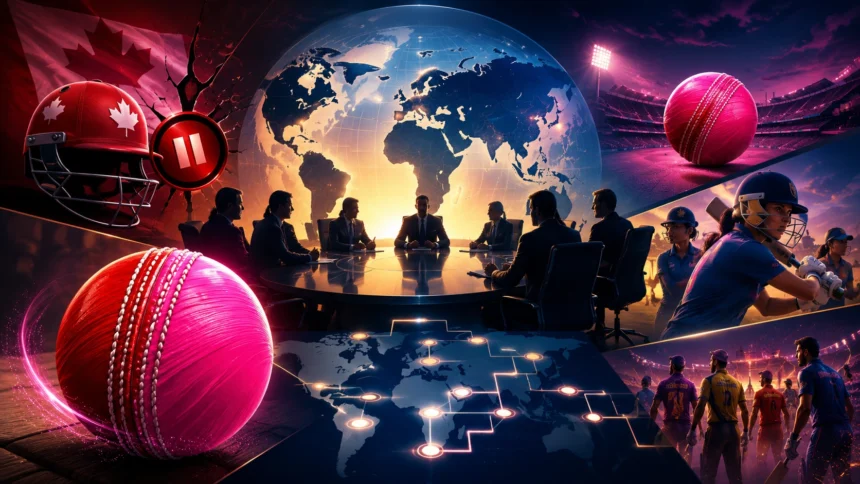
ICC Board Meeting brings big cricket changes: Cricket Canada suspension, pink-ball trial, global qualifiers and franchise cricket control.
- ICC Board Meeting: Cricket Gets A Rulebook Remix
- Quick Fact Box
- What Happened At The ICC Board Meeting?
- Why The ICC Board Meeting Matters Now
- Bigger Background: Cricket Canada’s Suspension
- Pink Ball In Regular Tests: Cricket’s New Emergency Torch?
- Global Qualifier: Associate Nations Get A Bigger Door
- Women’s Cricket Gets Calendar Attention
- Playing Conditions: Small Tweaks, Big Noise
- Franchise Cricket: The Elephant In Every Dressing Room
- What To Watch Next
- Nokjhok Take
- More Stories, You’ll Like
- FAQs
- 1. What happened in the ICC Board Meeting?
- 2. Why did ICC suspend Cricket Canada?
- 3. Can Canada still play ICC events?
- 4. What is the ICC pink-ball trial?
- 5. What is the new ICC Global Qualifier?
- 6. What changed in women’s cricket?
- 7. Why is ICC worried about franchise cricket?
- What do you think — is the ICC finally modernising cricket, or is this just another committee-powered cover drive?
ICC Board Meeting: Cricket Gets A Rulebook Remix
Cricket’s top bosses met in Ahmedabad, and clearly, they did not go there only for snacks, selfies and polite handshakes.
The latest ICC Board Meeting has delivered a full cricket buffet: Cricket Canada suspended, pink ball experiments in Tests, new global qualifiers, women’s cricket calendar changes, franchise cricket concerns and governance check-ups.
Basically, cricket’s operating system just got an update.
Some fans will ask, “Will this change tomorrow’s match?” Not directly. But these decisions can shape who plays, how Tests are saved from bad light, how smaller cricket nations get chances, and how franchise leagues fit into the bigger international calendar.
The International Cricket Council confirmed the decisions after its Board meetings in Ahmedabad on Sunday, May 31. Read the ICC Board meeting release (icc)
Quick Fact Box
| Point | Detail |
|---|---|
| What happened | ICC announced several major decisions after its Board meeting in Ahmedabad. |
| Who is involved | ICC, Cricket Canada, national cricket boards, Associate nations, women’s teams and franchise leagues. |
| Why it matters | These decisions affect governance, Test cricket rules, global qualification pathways and the future cricket calendar. |
| Current status | Cricket Canada is suspended, but Canadian teams can still play ICC events under a controlled funding system. |
| One surprising detail | ICC may trial switching from red ball to pink ball during regular Tests when poor light is expected. |
What Happened At The ICC Board Meeting?
The ICC Board Meeting produced a long list of decisions, but five stand out.
First, Cricket Canada’s ICC membership was suspended with immediate effect because of what the ICC called “serious breaches” of membership obligations. The ICC said Canadian national teams can continue participating in ICC events, and funding for national team programmes will be provided through a controlled mechanism. (icc)
Second, the ICC approved a trial where a pink ball can be used in conventional Test matches when poor light is expected, but only if both participating teams agree. This is meant to reduce time lost because of bad light. (Cricbuzz)
Third, the ICC approved the idea of creating a Global Qualifier for ICC Men’s T20 World Cups, with management asked to finalise the structure for a 16-team qualifier. (icc)
Fourth, women’s cricket got calendar and pathway updates, including a changed window for the ICC Women’s Champions Trophy 2027 and a qualification pathway for the ICC Women’s T20 World Cup 2028. (icc)
Fifth, the ICC expressed concern about the growing footprint of franchise cricket and decided to form a committee to study how franchise leagues can be better aligned with the international calendar. (icc)
That is not a meeting. That is cricket’s annual performance review.
Why The ICC Board Meeting Matters Now
This matters because cricket is no longer just “bat, ball, field, applause.”
Modern cricket is a giant machine. It has national boards, franchise leagues, broadcast deals, women’s tournaments, Associate nations, governance issues, player workload, technology, lighting problems and fans who want everything faster than a food delivery app.
The ICC is trying to solve several problems at once.
Bad light keeps interrupting Tests. Smaller cricket nations want better qualification opportunities. Franchise leagues are expanding like monsoon potholes. Women’s cricket needs stronger pathways. Governance problems in national boards can damage players who may have done nothing wrong.
Most people are missing one point: the ICC is not only managing matches; it is managing cricket’s traffic jam.
And this traffic jam has Test cricket, T20 leagues, women’s events, Associate teams and national boards all honking at the same time.
Bigger Background: Cricket Canada’s Suspension
The Cricket Canada decision is the sharpest headline.
The ICC said Cricket Canada has been suspended due to serious breaches of membership obligations. But it also made sure Canadian national teams are not punished immediately for board-level governance problems. Players can continue to play ICC events, and approved national team programmes can access funding through an ICC-controlled mechanism. (icc)
Reuters reported that the suspension came after the ICC’s anti-corruption unit began an investigation, following a CBC documentary that alleged corruption, match manipulation and threats of violence involving Cricket Canada officials and players. (Reuters)
The Guardian also reported that Cricket Canada faced allegations linked to corruption, governance failures and organized crime concerns, while noting that Canadian teams remain eligible for ICC events under controlled funding. (The Guardian)
This sounds simple, but the twist is important.
The ICC is separating the board from the players.
That is like saying: “The school management is under inquiry, but the students should still be allowed to sit for exams.”
And honestly, that is sensible. Players should not become collateral damage in an administrative drama.
Pink Ball In Regular Tests: Cricket’s New Emergency Torch?
Now let us talk about the pink ball.
Traditionally, red balls are used in day Tests, while pink balls are used in day-night Tests because they are easier to see under lights. But bad light remains one of Test cricket’s most annoying villains.
A match is flowing beautifully. Batters are settled. Bowlers are planning. Fans are invested. Then suddenly, the umpires check the light, players walk off, and everyone starts staring at clouds like amateur meteorologists.
The ICC has now approved a recommendation to trial using a pink ball in conventional Tests when poor light is expected, subject to agreement from both teams. Reuters reported that the idea is to maximise playing time and reduce interruptions. (Reuters)
Here’s the interesting part: this does not mean every Test will suddenly become a pink-ball party.
It is a trial. It requires agreement. It is condition-based.
But if it works, Test cricket may finally have a practical answer to the bad-light problem beyond “everyone please look worried until tomorrow morning.”
Global Qualifier: Associate Nations Get A Bigger Door
The ICC Board also approved a recommendation to establish a Global Qualifier for ICC Men’s T20 World Cups.
This is big for Associate nations.
Currently, many smaller cricket nations fight through regional pathways. That system gives structure, but it can also limit global exposure. A 16-team Global Qualifier could create a stronger, more visible final qualification stage.
The ICC has not finalised the full competition structure yet. Management has been asked to prepare it and present it to the relevant ICC committees. (icc)
This matters because cricket cannot keep calling itself global while giving the main stage mostly to the same familiar faces.
Associate cricket has produced powerful stories in recent years. Smaller teams have beaten bigger teams. Unknown players have become cult heroes. Fans love underdog cricket because it brings surprise, emotion and the beautiful possibility of a giant banana peel.
A proper Global Qualifier could give emerging teams more pressure games, better visibility and stronger development.
Women’s Cricket Gets Calendar Attention
Women’s cricket also received important updates.
The ICC Women’s Champions Trophy 2027 has been moved from its earlier June-July window to February 14-28, 2027. The ICC will also pilot a 10-team Women’s Emerging Nations Trophy in 2026, featuring five Full Members and five Associate Members. (icc)
For the ICC Women’s T20 World Cup 2028, hosted by Pakistan, India’s matches are scheduled at a neutral venue. The qualification pathway will include a 12-team tournament, with two spots decided through a 10-team Global Qualifier supported by Regional Qualifiers. (icc)
That is not just calendar management. That is pathway building.
Women’s cricket needs more matches, better structures, stronger emerging-nation competitions and clearer qualification ladders. Talent exists. The question is whether systems can give that talent enough oxygen.
The ICC seems to be saying: “Yes, women’s cricket needs a proper highway, not a narrow lane with occasional streetlights.”
Playing Conditions: Small Tweaks, Big Noise
The ICC also approved playing-condition changes.
One change is the permanent adoption of the leg-side wides trial, where the batter’s position at the point of delivery is used as the reference point. Another decision allows match officials to use Hawk-Eye data when reviewing reports of suspected illegal bowling actions. Head coaches or designated representatives will also be allowed to communicate with players during scheduled drinks breaks, and T20 Internationals will now have mandatory 15-minute intervals. (Cricbuzz)
These may sound technical, but cricket is often decided by technicalities.
A wide call changes an over.
A drinks break changes strategy.
A bowling-action report can affect a career.
A playing condition can change how teams plan entire innings.
Cricket fans love emotion, but cricket administrators live in footnotes.
Franchise Cricket: The Elephant In Every Dressing Room
The ICC Board also raised concern over the growing footprint of franchise cricket and decided to form a committee to examine how franchise leagues can be better harmonised with the international calendar. (icc)
Translation: franchise cricket is growing fast, and the international calendar is sweating.
This is the cricket world’s big balancing act.
Franchise leagues bring money, entertainment, new audiences and player opportunities. But too many leagues can create workload issues, scheduling clashes and national-team availability problems.
A player today is not just choosing between domestic cricket and international cricket. He may be choosing between national duty, franchise contract, rest, travel, family time, fitness management and one more league whose logo has flames, thunder or a roaring animal.
The ICC cannot ignore this anymore.
Franchise cricket is not going away. But it must fit into a calendar that does not turn players into frequent-flyer zombies.
What To Watch Next
Watch five things.
First, Cricket Canada’s reinstatement conditions. The ICC Normalisation Committee will monitor progress, and membership restoration will depend on whether the conditions are fully met. (icc)
Second, the pink-ball Test trial. Fans will watch whether teams accept it and whether it actually reduces bad-light delays.
Third, the structure of the Men’s T20 World Cup Global Qualifier. Associate nations will be watching this closely.
Fourth, women’s cricket event planning. The new pathways could make emerging nations more competitive.
Fifth, the franchise cricket committee. Its recommendations may shape the future calendar and player availability.
Nokjhok Take
The ICC Board Meeting felt like cricket’s control room suddenly became active.
One screen showed governance trouble in Canada. Another showed pink balls ready to rescue Tests from bad light. A third showed Associate nations asking for a wider doorway. A fourth showed women’s cricket getting a better roadmap. And in the corner, franchise cricket was quietly expanding like a real estate developer with unlimited brochures.
The funny-but-true angle is this: cricket wants tradition, innovation, global growth, women’s expansion, franchise money and player protection — all at the same time.
That is not easy. That is like asking one spinner to bowl off-spin, leg-spin, pace, yorkers and also manage the scoreboard.
But the serious point is clear. Cricket is changing. The ICC is trying to prevent the game from becoming a beautiful but chaotic calendar festival.
Basically, this is not just a board meeting. This is cricket trying to clean its room before guests arrive.
Punchy one-liner: Cricket’s future is exciting, but someone finally has to manage the timetable.
More Stories, You’ll Like
- Test Cricket Rules Explained: Why Bad Light Still Stops Play
- Franchise Cricket Boom: Is The International Calendar In Trouble?
- Satwik Chirag Singapore Open Win: India Smashes History

FAQs
1. What happened in the ICC Board Meeting?
The ICC announced decisions on Cricket Canada’s suspension, pink-ball trials in Tests, global qualifiers, women’s cricket pathways and franchise cricket oversight.
2. Why did ICC suspend Cricket Canada?
ICC suspended Cricket Canada due to serious breaches of membership obligations and governance-related concerns.
3. Can Canada still play ICC events?
Yes. Canadian national teams remain eligible to participate in ICC events during the suspension period.
4. What is the ICC pink-ball trial?
The ICC approved a trial allowing teams to use a pink ball in conventional Tests when poor light is expected, if both teams agree.
5. What is the new ICC Global Qualifier?
The ICC approved a recommendation to establish a 16-team Global Qualifier for Men’s T20 World Cups. The structure is still being finalised.
6. What changed in women’s cricket?
The ICC changed the Women’s Champions Trophy 2027 window and approved pathways for emerging women’s teams and the 2028 Women’s T20 World Cup.
7. Why is ICC worried about franchise cricket?
The ICC is concerned that the rapid growth of franchise leagues may clash with the international calendar and affect player availability.
What do you think — is the ICC finally modernising cricket, or is this just another committee-powered cover drive?
Comment your view, share this with the cricket expert in your group chat, and read our next explainer before bad light stops the discussion.
Source reference: ICC official media release, Cricbuzz, Reuters, The Guardian, Times of India, Wisden.