




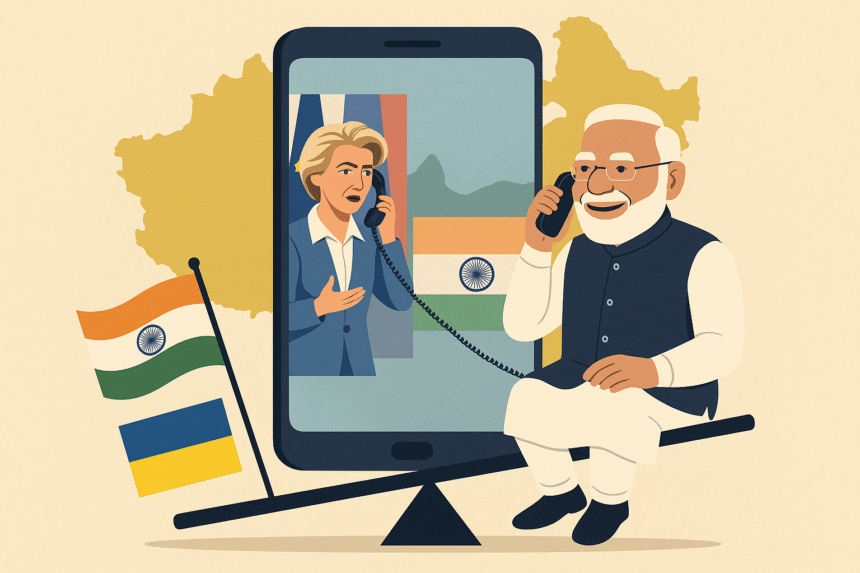
EU chief Ursula von der Leyen calls PM Modi, praising India’s role in pressing Russia to end the Ukraine war and chart a path to peace.
Diplomacy often looks like chess, but sometimes it feels like a WhatsApp call. This week, the EU chief picked up the phone, dialed PM Modi, and essentially said: “Thanks, India, you’re doing great—now help us end this war.”
Who knew world peace could begin with a good old international phone call?
The Big Call
European Commission President Ursula von der Leyen spoke to Prime Minister Narendra Modi on Thursday. The agenda? The never-ending Russia-Ukraine conflict.
Von der Leyen praised India’s “important role” in pressing Russia to end the war and highlighted how India’s engagement could help carve out a peace path.
According to European Commission reports, the EU has been ramping up its diplomatic efforts to bring the conflict to a close, and India is now seen as a key player in that process.
Why India?
The question is obvious: why does Europe think India holds the key?
Here are the reasons:
- Strategic Position – India maintains friendly ties with both Russia and the West.
- Economic Leverage – India imports Russian oil but also trades heavily with Europe and the US.
- Political Credibility – India’s position as a leader of the Global South makes it a natural mediator.
In short, India is like that mutual friend who can calm down two people fighting at a party.
What Ursula Said
Von der Leyen didn’t mince words. She said:
- India is playing an “important role in bringing Russia to end its war of aggression.”
- India’s continued engagement with President Zelenskyy is welcome.
- A peaceful resolution is not just Europe’s need, but the world’s.
Her remarks also went public on Twitter (now X), where she posted about her “pleasure speaking with Prime Minister @narendramodi.”
What India Said
While the EU chief’s praise grabbed headlines, India’s side of the story is clear too. New Delhi has consistently said:
- Dialogue, not weapons, is the way forward.
- The sovereignty and territorial integrity of all nations must be respected.
- Humanitarian concerns (fuel, food, fertilizers) matter as much as geopolitics.
Essentially, India is advocating a balanced middle ground—a voice of reason in a noisy world.
The Background: Ukraine War and Global Stakes
The Russia-Ukraine war, now dragging into years, has created ripple effects:
- Global inflation and energy crises.
- Food shortages in vulnerable nations.
- A test of global alliances.
With NATO firmly backing Ukraine and Russia showing no signs of retreat, India’s neutral-yet-influential position has become crucial.
As BBC World News has often highlighted, India’s diplomatic balancing act has made it a go-to country for mediation attempts.
The Symbolism of the Call
This wasn’t just any phone call. It symbolized three key things:
- Acknowledgment of India’s Clout – Europe sees India not as a bystander, but as an active stakeholder.
- Trust in Modi’s Diplomacy – From G20 leadership to BRICS summits, Modi has carved out space in global diplomacy.
- Pressure on Russia – When friends of Moscow nudge, the Kremlin tends to notice.
The Fun Angle: Diplomacy as a Phone Plan
Let’s be honest, the world often jokes about how global leaders talk more than teenagers on Instagram. This time, the EU chief’s call to PM Modi was less about emojis and more about ending a bloody conflict.
Still, if peace could be brokered over an international call, maybe the UN should consider launching a “World Peace Hotline.”
India’s Diplomatic Style
India’s diplomacy has always had a unique flavor:
- Non-Aligned, but Not Silent – Echoes of Nehru’s non-alignment, updated for the 21st century.
- Friends with All, Enemies with None – From Moscow to Washington, India shakes hands everywhere.
- Practical Peacekeeping – Focus on fuel, food, and fertilizers ensures peace talks aren’t just theory.
It’s a style that’s winning applause globally—and the EU’s latest praise is proof.
Why This Call Matters Globally
- Boosts India’s Image – From regional power to global peace player.
- Encourages Dialogue – If India pushes, Russia may at least listen.
- Hope for Resolution – Even symbolic gestures matter in long wars.
In short, India is no longer just watching history—it’s writing it.
Critics and Counterpoints
Of course, not everyone is convinced. Some argue that India’s oil deals with Russia dilute its credibility. Others say India should take a clearer stance.
But here’s the counter: diplomacy isn’t about taking sides, it’s about making sides talk. And that’s exactly what India is trying to do.
What Next?
With more talks lined up, the real test is whether:
- Russia listens to India’s nudge.
- Ukraine values India’s mediation.
- Europe continues to involve India deeply.
If all goes well, India might just help shape the blueprint for peace.
The Bigger Picture
This call reflects a shifting world order:
- Europe looks to India as a partner, not just a market.
- India becomes central in conflicts far from its borders.
- Multipolar Diplomacy is the new normal, where no single bloc dominates.
In a sense, the Ukraine war has forced the world to rediscover India as more than just “the land of spices and software.”
Do you think India can genuinely mediate peace between Russia and Ukraine? Or is this just polite diplomatic praise? Share your thoughts, debate with your friends, and keep the conversation alive—because sometimes, peace begins with dialogue among us too.
Related Post Suggestion
“Putin–Sharif Meet: Balancing Russia Between India and Pakistan”