





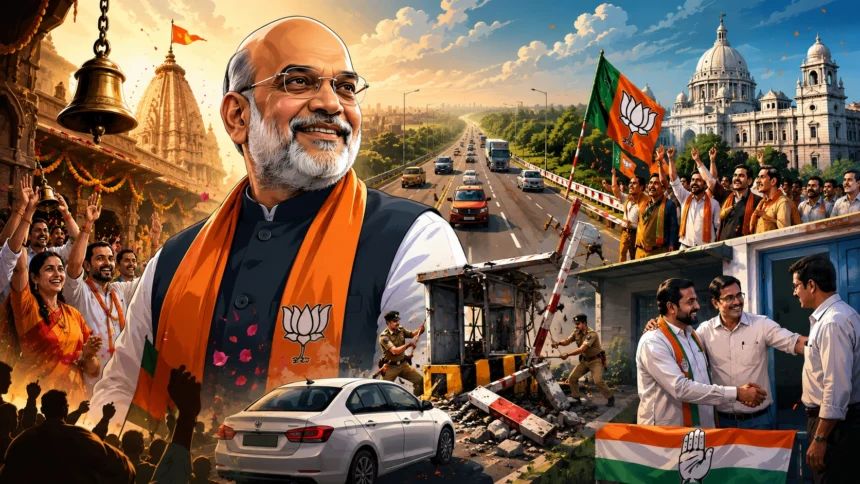
BJP’s win has triggered fast changes—temples reopened, fake tolls stopped, and political offices reclaimed
- Power Shift, Instant Action
- Bengal News Today: What Actually Happened?
- BJP’s Big Win Changed The Mood
- Closed Temples Reopen: Symbolism Is Loud
- Fake Toll Booths Removed: Roadside Economy Shaken
- Congress Gets Back Offices: The Unexpected Bonus Track
- But Bengal Is Also Seeing Violence
- Bengal News Today: What Experts Are Noticing
- Why This Change Matters Beyond Bengal
- The Hidden Lesson: Power Shift Is Easy, System Shift Is Hard
- Conclusion: Bengal News Today Is Bigger Than Politics
- FAQs
- 1. What is the main Bengal News Today update?
- 2. How many seats did BJP win in West Bengal 2026?
- 3. How many seats did TMC win?
- 4. Why are temples reopening important?
- 5. What are fake toll booths?
- 6. Is Bengal peaceful after the election?
- 7. Why is Bengal News Today important nationally?
- Related Post Suggestion
- What do you think—real change or just political trailer before the full movie?
Power Shift, Instant Action
Breaking news from Bengal: the chair has changed, and suddenly the state looks like someone pressed the “factory reset” button.
Closed temples are opening.
Fake toll points are disappearing.
Congress is getting back offices it had almost forgotten like an old Gmail password.
And Bengal politics, as usual, is not walking calmly—it is entering with background music.
Here is the punchline: in Bengal, even administrative change arrives with full political masala.
According to the Election Commission of India’s official result page, BJP won 207 seats, while AITC won 80 seats in the West Bengal Assembly election results. That is not just a win; that is a political earthquake wearing formal shoes. Readers can check the official result data on the Election Commission of India result page. (Election Commission of India)
And now, before the new government’s oath ceremony, Bengal is already seeing action on roads, temples, offices, and political tempers.
Bengal News Today: What Actually Happened?
The story is simple, but the background is spicy.
After BJP’s historic win in West Bengal, reports say several visible changes have started appearing across the state. Navbharat Times reported that temples shut for years were reopened, illegal toll collection points were removed, and Congress offices allegedly occupied earlier were reclaimed after the power change. (Navbharat Times)
Now, this sounds like a movie montage.
Scene one: temple bells start ringing again.
Scene two: road toll boys vanish faster than free Wi-Fi.
Scene three: Congress workers discover, “Arre, our office still exists!”
But behind the humour, there is a serious political message.
Whenever power changes after a long rule, the first few days become a public signal. New rulers want to show control. Old networks start shaking. Local workers test the mood. Administration starts checking which side the wind is blowing.
And Bengal’s wind is currently blowing like a ceiling fan on speed five.
BJP’s Big Win Changed The Mood
BJP’s 207-seat performance has ended TMC’s long dominance in the state. Times of India reported that BJP crossed the majority mark comfortably and is preparing to form its first-ever government in West Bengal. (The Times of India)
The swearing-in ceremony is expected on May 9 at Kolkata’s Brigade Parade Ground, with Prime Minister Narendra Modi and other senior BJP leaders likely to attend. Suvendu Adhikari is being seen as a leading name in the Chief Minister race, according to reports. (The Economic Times)
This is why every small incident is now getting national attention.
A temple opening is no longer just a temple opening.
A toll booth removal is no longer just a road issue.
A Congress office being reclaimed is no longer just “property matter.”
Everything now has one headline: change has arrived.
Closed Temples Reopen: Symbolism Is Loud
One of the biggest emotional stories is about temples reopening after years.
Reports say several temples that were locked or inactive due to local pressure or disputes have started seeing worship again. Videos from different parts of Bengal have shown locals cleaning temple premises, removing dust, and restarting puja. (Navbharat Times)
Now, let’s be honest.
In India, a locked temple is never just a locked building.
It is emotion, memory, fear, politics, and neighbourhood gossip packed into one structure.
So when temples reopen after power change, the message becomes bigger than religion. It tells supporters: “The atmosphere has changed.” It tells opponents: “The old system is no longer the same.”
Here’s the strange part: the actual administrative process may take time, but public emotion moves faster than a viral WhatsApp forward.
Fake Toll Booths Removed: Roadside Economy Shaken
Another big claim is that illegal toll collection points on roads have been stopped.
According to reports, at some locations, people who were earlier collecting money from vehicles allegedly disappeared after the power shift. (Navbharat Times)
This is where the common man’s interest begins.
Because politics is one thing. But when a truck driver, taxi owner, trader, or small businessman stops paying random roadside “chai-paani tax,” then democracy suddenly feels very practical.
Imagine this:
Earlier: “Bhai, toll do.”
Driver: “But where is the receipt?”
Collector: “Receipt? Aap Bengal mein naye ho kya?”
Now, reports suggest such collections are facing pressure. If properly enforced, this could reduce harassment, improve movement of goods, and send a strong law-and-order message.
But warning: removing illegal tolls is not a one-day photo-op job. It needs regular policing, public complaint systems, and strict action against local strongmen.
Otherwise, fake toll booths behave like mushrooms. One rain, and they return.
Congress Gets Back Offices: The Unexpected Bonus Track
Perhaps the funniest twist in this whole political drama is Congress.
Reports say some Congress offices that had allegedly been occupied earlier were reopened or reclaimed after the power shift. (Navbharat Times)
Now this is peak Indian politics.
BJP wins.
TMC loses.
Congress gets office.
This is like your neighbour winning the lottery and you finding your missing scooter key.
But the issue is serious. Party offices are not just rooms with old posters. They are local political identity points. If a party loses access to its office, it loses visibility, confidence, and ground presence.
So, when Congress gets back offices, it quietly shows that the local fear structure may be changing.
And most people ignore this hidden point: power change does not only benefit the winning party. It can also create breathing space for smaller or weakened opposition forces.
But Bengal Is Also Seeing Violence
Now let’s not paint everything with festival colours.
The political transition has also seen serious tension. The Guardian reported that post-poll violence in West Bengal led to deaths, arrests, and rising political confrontation after BJP’s victory. (The Guardian)
Reports also mentioned the killing of a BJP aide and continuing accusations between BJP and TMC. (The Guardian)
This is the uncomfortable truth.
Change can bring hope.
Change can bring speed.
But change can also bring revenge politics.
And Bengal’s political history has never been a silent documentary. It has always been a loud theatre with slogans, cadres, street muscle, and high emotion.
So the real test for the new government will not be whether it can open one temple or remove one toll point.
The real test will be whether it can stop violence without turning governance into counter-violence.
Bengal News Today: What Experts Are Noticing
Experts are watching three things closely.
First, whether the BJP government can convert its huge mandate into calm administration.
Second, whether old local networks linked with illegal collection, political occupation, and intimidation will truly be dismantled.
Third, whether law and order will improve without selective targeting.
The Election Commission result shows BJP at 207 seats, far above the majority mark of 148 in a 294-seat Assembly. (Election Commission of India) That gives the party political strength. But strength is not the same as stability.
Stability comes from police neutrality, local administration discipline, and public confidence.
Because one viral video may win applause. But one wrong arrest or one revenge attack can damage the whole narrative.
Why This Change Matters Beyond Bengal
Bengal is not just another state.
It has cultural depth, border sensitivity, political intensity, and a long history of cadre-based politics. What happens in Bengal affects national narratives.
If BJP manages governance well, it can say: “Look, we changed Bengal.”
If violence rises, TMC will say: “See, this is political revenge.”
If Congress gets space, it may try to rebuild slowly.
If illegal systems collapse, ordinary citizens may feel immediate relief.
That is why Bengal News Today is not just about temples, tolls, and offices. It is about whether a state known for political drama can now deliver administrative discipline.
The Hidden Lesson: Power Shift Is Easy, System Shift Is Hard
Winning elections is like getting admission into a tough college.
The real exam starts after the celebration.
BJP has got the mandate. Now it must prove that change means better governance, not just new flags.
For common people, the checklist is simple:
Will roads become safer?
Will illegal collections stop permanently?
Will political violence reduce?
Will administration treat citizens equally?
Will old fear be replaced by rule of law?
If the answer becomes yes, Bengal may see real transformation.
If not, then the headline will change from “change has arrived” to “same movie, new cast.”
Conclusion: Bengal News Today Is Bigger Than Politics
Bengal News Today is giving one clear signal: after BJP’s big win, the state is moving through a fast and dramatic reset.
Temples reopening, fake tolls stopping, Congress offices being reclaimed, and government formation preparations all show visible change. But post-poll violence and political tension are also serious warnings.
The final question is not whether power changed.
The real question is: will life change for ordinary people?
Because Bengal has heard slogans for decades. Now it wants receipts.
FAQs
1. What is the main Bengal News Today update?
The main update is that after BJP’s 2026 win, reports say closed temples reopened, fake tolls stopped, and some political offices were reclaimed.
2. How many seats did BJP win in West Bengal 2026?
According to ECI data, BJP won 207 seats in the West Bengal Assembly election. (Election Commission of India)
3. How many seats did TMC win?
The Election Commission result page shows AITC winning 80 seats in West Bengal. (Election Commission of India)
4. Why are temples reopening important?
Temples reopening is symbolic because it suggests a shift in local power, public confidence, and administrative mood after the election.
5. What are fake toll booths?
Fake toll booths are illegal roadside collection points where money is allegedly taken from vehicles without lawful authority.
6. Is Bengal peaceful after the election?
No. Reports mention post-poll tension, arrests, and violence, so law and order remains a major challenge. (The Guardian)
7. Why is Bengal News Today important nationally?
Bengal’s political shift affects national politics, BJP’s eastern strategy, opposition dynamics, and governance debates.
Related Post Suggestion
Women Safety Card: BJP’s Bengal Masterstroke
What do you think—real change or just political trailer before the full movie?
Drop your thoughts in the comments, share this with that friend who debates politics at breakfast, and explore more Nokjhok explainers before the next breaking news starts shouting from your phone.
Credit: NBT