





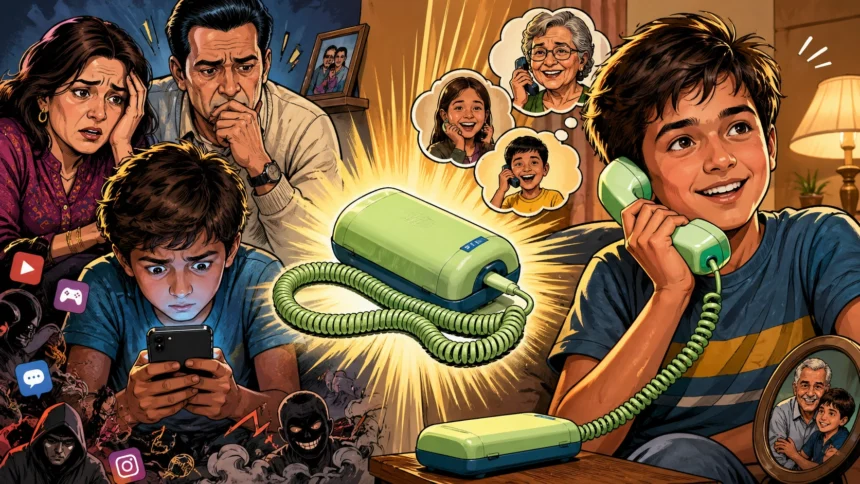
Phone for Children is going viral as parents choose a $100 landline-style device to cut screen addiction and keep kids connected.
- The Landline Has Entered the Chat
- What Is This Phone for Children?
- Why Is This $100 Phone Suddenly Going Viral?
- Phone for Children: How Tin Can Works
- It Runs Through Wi-Fi
- It Has No Screen Distraction
- Parents Control Contacts
- Calls Between Tin Can Devices Can Be Free
- Why Parents Are Choosing Old-School Tech
- The Big Funding Signal: Investors Are Listening Too
- Schools Are Also Joining the Movement
- What Makes Voice Calls So Different?
- The Bigger Screen-Time Problem
- Why Kids Actually Like It
- But Is Tin Can Perfect? Not Exactly
- Phone for Children: Is It Useful for Indian Parents?
- What Parents Should Check Before Buying Such a Device
- 1. Does It Work in Your Country?
- 2. Is There a Monthly Plan?
- 3. Can You Control Contacts?
- 4. Can Emergency Calls Work?
- 5. What Happens During Internet Failure?
- Final Take: The Landline Is Back, But Smarter
- 1. What is Phone for Children?
- 2. What is Tin Can phone?
- 3. How much does Tin Can cost?
- 4. Can children call anyone from Tin Can?
- 5. Why are parents buying this phone?
- 6. Is Tin Can available in India?
- 7. Is this better than a smartphone for children?
- Would you give your child a smartphone—or a smart landline like Tin Can?
- Suggested Related Post
The Landline Has Entered the Chat
Breaking news from Parenting Planet.
The smartphone has a new enemy.
Not Apple.
Not Samsung.
Not another AI gadget.
It is a cute little landline-style phone that looks like it escaped from 1998 and joined a Silicon Valley startup.
This Phone for Children is called Tin Can, a $100 Wi-Fi landline-style device that lets kids make voice calls without apps, games, texting, social media, or infinite scrolling. The company describes it as a screen-free phone where children can call only approved contacts. (Tin Can)
One-line truth: Parents wanted less screen time, and America accidentally rediscovered the landline.
What Is This Phone for Children?
The device is called Tin Can.
It is a modern landline-style phone designed especially for children. It does not work like a smartphone. There is no Instagram. No YouTube Shorts. No gaming apps. No group chat drama. No “one last video” that becomes a 90-minute rabbit hole.
Instead, it focuses on one old-school thing: voice calls.
According to the company’s website, Tin Can is a Wi-Fi landline for kids with no apps, texting, games, or strangers. Parents approve who can call the child, and children can speak to friends, grandparents, neighbours, or approved contacts. (Tin Can)
Basically, it gives kids connection without handing them the full internet jungle.
In parenting language: “Beta, you can talk, but you cannot scroll.”
Why Is This $100 Phone Suddenly Going Viral?
The biggest reason is simple.
Parents are tired.
They want children to stay connected, but they do not want to hand over a smartphone too early. The modern parent’s dilemma is very real: give the child a phone, and the child enters the world of reels, games, notifications, algorithms, strangers, and screen fights. Don’t give the child a phone, and the parent becomes the child’s personal call centre.
Tin Can arrived in this gap.
The device reportedly costs around $100 and has become popular among families looking for smartphone alternatives. Bloomberg reported that the $100 landline-inspired Wi-Fi device has gone viral over the last 12 months. (Bloomberg)
And here’s the strange part: children are actually using it.
Yes, in 2026, kids are getting excited about a landline.
Somewhere, every 90s kid is smiling emotionally while hearing a phantom dial tone.
Phone for Children: How Tin Can Works
Tin Can is not exactly the old landline that needed copper wiring and came with a bill that made fathers emotional.
It is a modern version.
It Runs Through Wi-Fi
The phone uses internet connectivity, not traditional landline wiring.
It Has No Screen Distraction
No apps. No texting. No browsing. No social media.
Parents Control Contacts
Only approved contacts can call the child, and parents manage this through a companion app. Cybernews reported that parents can approve contacts and use features such as quiet hours and Do Not Disturb. (Cybernews)
Calls Between Tin Can Devices Can Be Free
Tin Can-to-Tin Can calls are free, while calling outside numbers may require a paid plan. Cybernews reported that calls to cell phones can be made through a monthly plan. (Cybernews)
So the formula is clever:
Old landline feeling.
Modern safety layer.
Parent-approved contacts.
No attention economy drama.
This is not just a phone. It is a parenting peace treaty.
Why Parents Are Choosing Old-School Tech
Most people think innovation means adding more features.
But Tin Can is doing the opposite.
It removes features.
No camera.
No apps.
No addictive feed.
No internet browsing.
No late-night scrolling.
No “just checking one notification.”
This is why it feels fresh.
Fast Company reported that Tin Can is a voice-first, screen-free alternative, and the company has raised major funding while previous batches sold out quickly. (Fast Company)
This is what experts call “retro innovation.”
It looks old.
But the problem it solves is very new.
Parents do not hate technology. They hate technology that kidnaps attention.
The Big Funding Signal: Investors Are Listening Too
This is not only a cute parenting trend.
Money is also entering the room.
GeekWire reported that the Seattle startup behind Tin Can raised $12 million in funding to meet demand for its landline-style phone for kids. (GeekWire)
That is a serious signal.
Investors do not usually throw millions at nostalgia unless nostalgia has a business model.
And this one does.
Parents are searching for a middle path between two extremes:
One extreme: full smartphone at age 8.
Other extreme: no communication tool at all.
Tin Can sits in the middle.
It says: “Let kids talk. Just don’t give them the whole internet.”
Schools Are Also Joining the Movement
The trend is not limited to homes.
Schools are watching too.
In Kansas, Nativity Parish School saw families adopt Tin Can phones as part of a screen-free childhood approach. A report by OSV News said more than 200 families from kindergarten through fifth grade opted to trade smartphones for old-fashioned landline-style phones. (OSV News – We’ve got the Church covered)
Another example mentioned in reports is St. James’ Episcopal School in Los Angeles, where families were also exploring this kind of phone to keep children connected without depending on group chats and smartphones.
This makes sense.
Schools are among the first places to notice the screen-time problem.
Teachers see attention dropping.
Parents see mood swings.
Children see everyone else online and want entry.
So a screen-free phone becomes more than a gadget.
It becomes a social experiment.
What Makes Voice Calls So Different?
Here’s the hidden truth most people ignore:
Texting is not the same as talking.
Voice calls teach children how to pause, listen, respond, interrupt politely, manage silence, and explain themselves.
Tin Can founder Chet Kittleson has said voice conversations help children build stronger communication skills and navigate natural pauses in conversation. (The Times of India)
That may sound small.
But it is big.
Children today can send emojis before they can handle awkward silence.
A landline-style phone forces them to use their voice. It brings back a tiny but important skill: real conversation.
And honestly, many adults also need this update.
The Bigger Screen-Time Problem
The rise of Tin Can is happening at a time when the world is worried about children and screens.
The U.S. Surgeon General’s advisory on social media and youth mental health says up to 95% of youth aged 13–17 report using a social media platform, with more than one-third saying they use social media “almost constantly.” It also says there is not enough evidence to conclude social media is sufficiently safe for children and adolescents. (HHS.gov)
That is not a small warning.
That is a giant digital red flag.
Around the world, governments are also trying to act. Australia’s under-16 social media restriction came into effect in December 2025, with platforms required to take steps to prevent under-16 users from having accounts. (UNICEF Australia)
So Tin Can is not appearing in isolation.
It is part of a bigger cultural question:
How do we keep children connected without making them addicted?
Why Kids Actually Like It
This sounds ridiculous, but many children enjoy the phone because it gives them independence.
They can call a friend.
They can ask about homework.
They can plan a walk.
They can speak to grandparents.
They can coordinate playdates without parents acting as WhatsApp managers.
Business Insider reported that founder Chet Kittleson built Tin Can after seeing how difficult it had become for parents to manage kids’ social lives without cellphones. He said the phone helps children build independence and communicate directly. (Business Insider)
That is the funny twist.
A device that looks old may actually give children a new kind of freedom.
Not the freedom to scroll.
The freedom to speak.
But Is Tin Can Perfect? Not Exactly
No gadget is magic.
Tin Can also faced technical challenges. Business Insider reported that the service had a major Christmas 2025 crash because call volume surged massively, and the company had to slow shipments and work on reliability. (Business Insider)
This matters.
Parents buying such a device should know that it is still a young startup product, not a century-old telecom giant.
There may be network issues.
There may be subscription conditions.
There may be country availability limits.
There may be calling restrictions.
So yes, it is promising.
But don’t throw your smartphone into the dustbin yet.
Phone for Children: Is It Useful for Indian Parents?
In India, the idea is very interesting.
Urban Indian parents are already worried about screen addiction, YouTube obsession, gaming, online strangers, and social media pressure.
A product like Tin Can—or a similar Indian version—could work well for:
- Children aged 6–12
- Grandparent calling
- Emergency communication
- Society friends and school friends
- Screen-free family routines
- Parents delaying smartphones
But Indian pricing will matter.
A $100 phone is roughly ₹8,000–₹9,000 depending on exchange rates. Add subscription cost, taxes, shipping and service issues, and it may become expensive for many families.
Still, the concept is powerful.
Maybe the next big Indian parenting product will not be another kids’ tablet.
Maybe it will be a “smart landline” for home.
What Parents Should Check Before Buying Such a Device
Before getting excited, check these five things:
1. Does It Work in Your Country?
Some features may be limited to the U.S. or Canada.
2. Is There a Monthly Plan?
The phone price is one thing. Calling plans are another.
3. Can You Control Contacts?
This is the main safety feature.
4. Can Emergency Calls Work?
Parents must check this carefully.
5. What Happens During Internet Failure?
Wi-Fi phones depend on internet connectivity.
This is where the old landline still laughs proudly from retirement.
Final Take: The Landline Is Back, But Smarter
The Phone for Children trend shows one big truth:
Parents do not want children to disappear into screens.
They want connection.
They want safety.
They want independence.
They want less digital drama.
Tin Can has become popular because it gives families a simple promise: kids can talk without entering the social media circus.
It is not anti-tech.
It is anti-overdose.
And maybe that is the future of parenting tech—not more screens, but better boundaries.
A $100 landline-style phone going viral in America proves one thing clearly:
Sometimes the next big thing is the old thing, redesigned smartly.
FAQs
1. What is Phone for Children?
Phone for Children refers to screen-free calling devices like Tin Can, designed to help kids communicate without smartphones.
2. What is Tin Can phone?
Tin Can is a Wi-Fi landline-style phone for kids with no apps, no texting, no internet browsing, and parent-approved contacts.
3. How much does Tin Can cost?
Tin Can is listed around $100, though plans and availability may vary by country and model.
4. Can children call anyone from Tin Can?
No. Parents approve contacts through a companion app, so children can call only allowed numbers or devices.
5. Why are parents buying this phone?
Parents want children to stay connected while avoiding smartphone addiction, social media, gaming, and endless screen time.
6. Is Tin Can available in India?
Reports say Tin Can is mainly available in the U.S. and Canada. Indian availability may be limited or require checking with the company.
7. Is this better than a smartphone for children?
For young children, it may be better if parents only want calling and safety without apps, social media or screen distraction.
Would you give your child a smartphone—or a smart landline like Tin Can?
Comment your view, share this with every parent fighting the “phone kab milega?” battle, and explore more smart parenting stories on Nokjhok.com.
Forward this before the next family meeting turns into a screen-time parliament session.
Suggested Related Post
“DeepSeek V4: China’s AI Bombshell Hits OpenAI”
Credit: NBT