





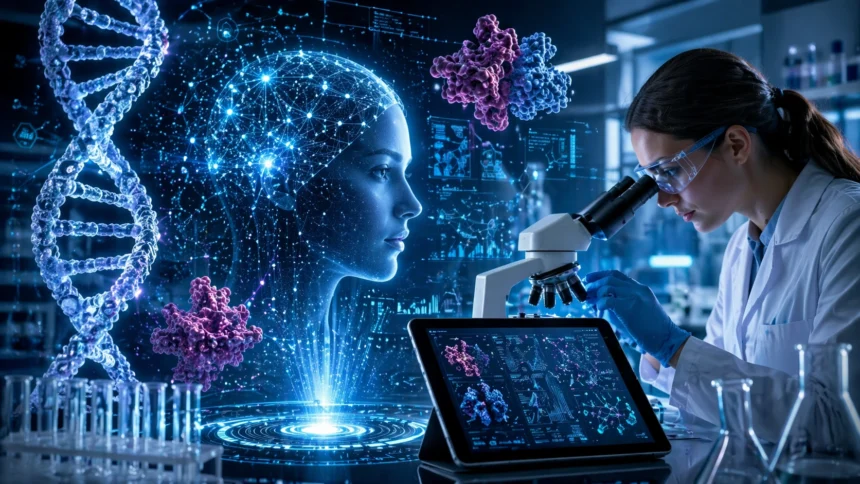
GPT Rosalind is OpenAI’s new life sciences AI model. Can it speed up drug discovery, genomics and personalised medicine?
- Science Just Got a Turbo Button
- What Is GPT Rosalind?
- Why GPT Rosalind Is Creating So Much Buzz
- GPT Rosalind and the 10–15 Year Drug Discovery Problem
- How GPT Rosalind Helps Scientists
- 1. Evidence Synthesis
- 2. Hypothesis Generation
- 3. Experimental Planning
- 4. Genomics and Protein Reasoning
- 5. Scientific Tool Use
- Why Big Pharma Is Interested
- Can GPT Rosalind Make Personalised Medicine Real?
- Why GPT Rosalind Is Not for Everyone
- What Makes GPT Rosalind Different From Normal ChatGPT?
- The Hidden Challenge: Testing and Trust
- What Experts Are Quietly Noticing
- 1. AI Is Moving From Chatbots to Specialist Models
- 2. Science Workflows Are Becoming AI-Native
- 3. Big Companies Want Research Speed
- What Common People Should Understand
- Conclusion: GPT Rosalind Could Change Medical Research
- 1. What is GPT Rosalind?
- 2. Why is it called GPT Rosalind?
- 3. Can GPT Rosalind create new medicines?
- 4. Can GPT Rosalind reduce drug discovery time?
- 5. Who can use GPT Rosalind?
- 6. Is GPT Rosalind available to normal users?
- 7. Why is GPT Rosalind important?
- What do you think—will GPT Rosalind become the biggest medical AI breakthrough, or is the world getting too excited too soon?
- Suggested Related Post
Science Just Got a Turbo Button
Something big has entered the medical lab.
No, not a new injection.
Not a new hospital machine.
Not another “miracle cure” WhatsApp forward from uncle ji.
This time, it is GPT Rosalind, OpenAI’s new AI model built for life sciences research.
And the claim is spicy: work that usually takes years may become dramatically faster.
One-line truth: If normal research is a bullock cart, GPT Rosalind wants to arrive like Vande Bharat with lab coat.
OpenAI says GPT Rosalind is a purpose-built model for biology, drug discovery and translational medicine, designed to help researchers with scientific workflows like evidence synthesis, hypothesis generation, experimental planning, genomics analysis, protein reasoning and biochemistry tasks. (OpenAI)
What Is GPT Rosalind?
GPT Rosalind is OpenAI’s specialised AI model for life sciences research.
In simple English, it is not made for writing birthday captions or solving “what should I eat tonight?” problems.
It is built for scientists.
It helps researchers understand huge amounts of scientific information, connect data from different tools, read research papers, analyse genes and proteins, and plan experiments faster.
The name Rosalind comes from Rosalind Franklin, the scientist whose X-ray crystallography work played a major role in understanding the structure of DNA. So yes, the naming is not random. It has full science nostalgia and respect attached.
OpenAI has positioned GPT Rosalind as its most capable model for life sciences research, especially useful for bioinformaticians, computational biologists and early discovery biologists. (OpenAI Help Center)
Why GPT Rosalind Is Creating So Much Buzz
Drug discovery is not like ordering food online.
You don’t click “make medicine,” wait 30 minutes and get a cure delivered with ketchup sachets.
Developing a new drug can take 10 to 15 years from early target discovery to approval. It involves research, testing, experiments, failures, clinical trials, regulatory reviews and huge costs. Reuters reported that GPT Rosalind has been launched to help advance life sciences research, including biochemistry, drug discovery and translational medicine. (Reuters)
This is why GPT Rosalind matters.
If AI can reduce even a small part of the time spent in early research, the impact can be massive.
We are talking about:
Faster disease understanding
Better drug target discovery
Smarter experiment planning
Lower research waste
More personalised treatment ideas
Here’s the strange part: this AI may not directly “invent medicine” like a movie scientist. But it can help scientists reach better ideas faster.
And in medicine, faster ideas can mean faster hope.
GPT Rosalind and the 10–15 Year Drug Discovery Problem
Let’s decode the big claim.
When people say GPT Rosalind can help finish “10–15 years of work in days,” it does not mean the full medicine approval process becomes a weekend project.
Clinical trials, human safety testing and regulatory approvals will still take time.
No serious company can say, “AI said it works, so let’s give it to everyone from Monday.”
That would be science wearing comedy shoes.
The real point is this:
GPT Rosalind may speed up the early research stage where scientists study disease biology, identify promising targets, connect evidence, design experiments and decide where to focus.
OpenAI says the model is built for deep scientific reasoning and stronger tool/database use across protein understanding, genomics analysis and biochemistry reasoning. (OpenAI Help Center)
So the “few days” idea is mostly about research acceleration—not instant medicine approval.
That distinction matters.
How GPT Rosalind Helps Scientists
Think of a scientist working on a disease like cancer, Parkinson’s or Alzheimer’s.
Earlier, they might need to:
Read hundreds of research papers
Compare gene data
Understand protein behaviour
Study chemical interactions
Plan lab experiments
Use multiple scientific databases
Check past failures and current trials
Now imagine one smart AI assistant helping them across this maze.
GPT Rosalind can help with:
1. Evidence Synthesis
It can read and organise large scientific literature.
That means scientists spend less time drowning in PDFs and more time thinking.
2. Hypothesis Generation
It can suggest possible research directions.
Not final answers. But useful leads.
3. Experimental Planning
It can help design next-step experiments.
This can reduce wasted time and bad trial planning.
4. Genomics and Protein Reasoning
It can analyse complex gene-protein-disease relationships.
This is important because many diseases begin at the biological level, not at the symptom level.
5. Scientific Tool Use
OpenAI has also introduced life sciences tooling through Codex connections to scientific tools and databases, aimed at helping researchers work across different systems more efficiently. (Reuters)
In simple terms, GPT Rosalind is like a super research assistant that does not get tired, does not complain about coffee, and does not say “server down” after reading page 400.
Why Big Pharma Is Interested
Here’s the insider angle.
Big pharma companies are not interested because AI looks cool in PowerPoint.
They are interested because drug research is expensive, risky and painfully slow.
Reuters reported that companies including Amgen, Moderna and Thermo Fisher Scientific are among those integrating GPT Rosalind into workflows. (Reuters)
That is a serious signal.
When major pharma and research companies test an AI model, it usually means they see possible value in real workflows.
Not hype. Workflow.
And workflow is where AI either becomes useful—or becomes another shiny dashboard nobody opens after two weeks.
Can GPT Rosalind Make Personalised Medicine Real?
This is where the story gets exciting.
Personalised medicine means treatment designed according to an individual patient’s biology.
Instead of “same medicine for everyone,” the future could be:
Your gene profile
Your disease type
Your protein markers
Your risk factors
Your treatment response
Then the doctor may choose a better drug or dose.
GPT Rosalind could help researchers understand these biological patterns faster.
This does not mean your local clinic will give you AI-designed medicine tomorrow morning.
But it could push the world closer to a future where medicine becomes more personalised, more targeted and less trial-and-error.
That is a big deal.
Because today, many patients suffer not only from disease—but also from slow diagnosis, delayed treatment and medicines that do not work well for them.
Why GPT Rosalind Is Not for Everyone
Here’s the warning most people ignore.
GPT Rosalind is powerful, but it is not a public toy.
OpenAI says GPT Rosalind is currently available through a trusted-access research preview for eligible institutions. (OpenAI)
That means it is not like normal ChatGPT where anyone asks, “Make me a cancer drug in 5 steps.”
Good.
Because medical AI needs guardrails.
If misused, it can create false confidence, unsafe suggestions, wrong experimental ideas or misleading medical claims.
So access is limited to serious research institutions, pharma companies and qualified scientific teams.
In short: this AI is wearing a lab coat, not running a street-side advice stall.
What Makes GPT Rosalind Different From Normal ChatGPT?
Normal ChatGPT is a general-purpose assistant.
GPT Rosalind is domain-specific.
That means it is optimised for scientific workflows, life sciences reasoning and research-level tasks.
It is designed to understand more specialised contexts like:
Drug targets
Biochemistry
Protein engineering
Genomics
Scientific databases
Experiment planning
Research evidence
That makes it more useful for expert users.
A normal model may help explain biology in simple language.
GPT Rosalind is built to help researchers work with the biology itself.
Big difference.
One explains the recipe.
The other helps the chef improve the kitchen.
The Hidden Challenge: Testing and Trust
Now let’s remove the hype glasses.
Medical AI must be tested carefully.
Even if GPT Rosalind performs well, scientists still need to verify:
Is the hypothesis biologically valid?
Is the data reliable?
Is the experiment safe?
Is the output reproducible?
Is the model hallucinating?
Is the result clinically meaningful?
This is not social media content where “close enough” is acceptable.
In medicine, one wrong assumption can cost years, money or lives.
So GPT Rosalind should be seen as a research accelerator—not an automatic doctor.
The scientist remains the driver.
AI becomes the engine boost.
What Experts Are Quietly Noticing
Experts are watching three big changes.
1. AI Is Moving From Chatbots to Specialist Models
The next AI wave may not be one model for everything.
It may be specialised models for medicine, law, finance, coding, cybersecurity and research.
2. Science Workflows Are Becoming AI-Native
Researchers may soon work with AI from the first literature review to final experiment planning.
3. Big Companies Want Research Speed
If AI reduces early discovery time, companies can test more ideas and fail faster.
And in drug discovery, failing faster is also progress.
Because every failed path avoided saves money, time and lab effort.
What Common People Should Understand
For ordinary people, GPT Rosalind does not mean instant miracle cures.
But it may eventually help in five ways:
New drugs may be discovered faster.
Rare diseases may get more attention.
Treatment may become more personalised.
Research costs may reduce over time.
Scientists may find useful clues faster.
This is the real benefit.
Not magic.
Not miracle.
But meaningful acceleration.
And sometimes, acceleration itself saves lives.
Conclusion: GPT Rosalind Could Change Medical Research
GPT Rosalind is one of OpenAI’s most important steps into specialised scientific AI.
It is designed to help researchers understand biology, analyse data, generate hypotheses, plan experiments and speed up drug discovery workflows.
Will it finish 15 years of medical research in 15 days?
Not exactly.
But can it help scientists move faster in the early discovery process?
Very likely.
The real story is not that AI will replace scientists.
The real story is that scientists using AI may move much faster than scientists not using AI.
And that could change the future of medicine.
GPT Rosalind may not be a doctor.
But it could become the research assistant that helps doctors get better medicines sooner.
FAQs
1. What is GPT Rosalind?
GPT Rosalind is OpenAI’s specialised AI model for life sciences research, drug discovery, genomics and biochemistry.
2. Why is it called GPT Rosalind?
It is named after Rosalind Franklin, whose work helped reveal the structure of DNA.
3. Can GPT Rosalind create new medicines?
It can help scientists discover drug targets, analyse evidence and plan experiments, but medicines still need testing and approvals.
4. Can GPT Rosalind reduce drug discovery time?
It may speed up early-stage research, but clinical trials and regulatory approvals will still take years.
5. Who can use GPT Rosalind?
OpenAI says it is currently available through trusted access to eligible research institutions and partners.
6. Is GPT Rosalind available to normal users?
No, it is not broadly available for general public use at present.
7. Why is GPT Rosalind important?
It could help researchers work faster, reduce research waste and support more personalised medicine in the future.
What do you think—will GPT Rosalind become the biggest medical AI breakthrough, or is the world getting too excited too soon?
Comment your view, share this with your tech-and-health friend, and explore more decoded AI stories on Nokjhok.com.
Forward this before your family WhatsApp group declares AI has invented “one tablet for all diseases.”
Suggested Related Post
“Apple History: The “Byte” That Changed Everything”
Credit: OpenAI