





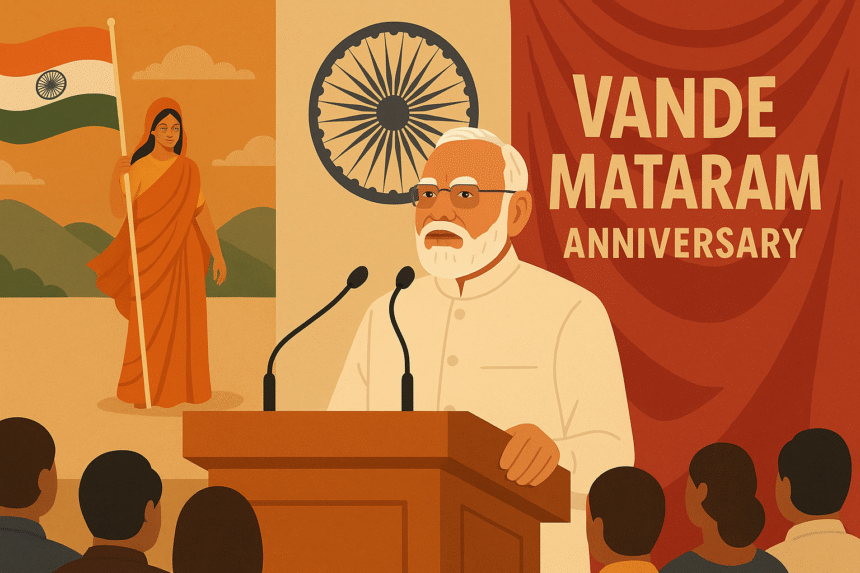
PM Modi revives the Vande Mataram debate, claiming key stanzas were cut in 1937. Here’s how politics, pride, and patriotism collide.
- 🇮🇳 “When a Song Sparks a Storm”
- 📜 The Origin Story: Bankim Babu’s Dream
- 🪶 Rabindranath Tagore’s Take: A Novel That Became a Nation
- ⚙️ 1937: The Political Cut That Still Hurts
- 🕊️ Vande Mataram: From Protest to Pride
- ⚔️ The Modern-Day Clash: BJP vs Congress
- 🧠 The Timelessness of “Vande Mataram”
- 🪔 Beyond Politics: Why Vande Mataram Still Matters
- 💬 Punchy One-Liner
- ❓ FAQs: Vande Mataram Controversy
- 1. Who wrote Vande Mataram?
- 2. Why is it controversial?
- 3. What did PM Modi say?
- 4. How did Congress respond?
- 5. Why does it still matter today?
- 🌺 A Note from History
🇮🇳 “When a Song Sparks a Storm”
Who would’ve thought that a 150-year-old song could trend harder than a Bollywood trailer? Yet here we are — “Vande Mataram”, India’s eternal anthem of pride, has once again become the centrepiece of a political orchestra.
Prime Minister Narendra Modi recently stirred the historical pot, claiming that key stanzas of the original Vande Mataram were dropped in 1937, calling it an injustice that “sowed the seeds of partition.”
Cue the political symphony — with Mallikarjun Kharge, the Congress President, clapping back like a tabla master on Twitter, saying the BJP and RSS “never sang it in their offices.”
So, what’s this all about? Let’s unfold the melody, the meaning, and the modern-day mayhem.
(To explore the roots of the song’s history, the National Archives of India has fascinating historical documents from the era.)
📜 The Origin Story: Bankim Babu’s Dream
“Vande Mataram” wasn’t just a song; it was an awakening.
Penned by Bankim Chandra Chatterjee in his 1882 novel Anandamath, the song became the heartbeat of India’s freedom struggle. It glorified Bharat Mata — a divine embodiment of India — calling on her children to rise, unite, and liberate their motherland.
Bankim Babu wrote it when India was drowning under British rule. The British justified their reign by branding Indians as “backward” and “inferior.” But Bankim countered that narrative beautifully with:
Sujalam, Suphalam, Malayaja Sheetalam…
(Rich with waters, abundant in fruits, and cool with the southern breeze.)
PM Modi, during his speech at the Vande Mataram@150 event, said —
It shattered British propaganda and showed India’s dream of prosperity.
Basically, the British called India poor. Bankim replied, “Hold my pen.” ✍️
🪶 Rabindranath Tagore’s Take: A Novel That Became a Nation
Even Gurudev Rabindranath Tagore was in awe. He once said that Anandamath wasn’t merely fiction — it was a vision of a free India.
The song transcended literature and entered the bloodstream of revolutionaries. It inspired countless freedom fighters to raise the slogan “Vande Mataram!” during protests and rallies — a battle cry for independence.
Tagore himself sang Vande Mataram at the 1905 Congress session, marking its emotional and historical might.
⚙️ 1937: The Political Cut That Still Hurts
Here’s where things got complicated.
During the Congress Faizabad Session in 1937, the party adopted Vande Mataram as its national song — but only after dropping certain stanzas.
Why? Because some Muslim leaders found portions of it religiously sensitive, viewing the depiction of Bharat Mata as idolatrous.
PM Modi revisited this moment, saying:
The song was broken into pieces, and that also broke the nation’s spirit.
According to him, this act — meant to appease — symbolised a deeper political division that later led to Partition.
Whether one agrees or not, there’s no denying the emotional gravity in his words.
🕊️ Vande Mataram: From Protest to Pride
Despite its political edits, Vande Mataram continued to unite hearts.
During the freedom movement, it was banned by the British — which ironically made it even more popular. When you outlaw a song, you don’t silence it; you immortalize it.
Today, it’s sung at government events, schools, and cultural ceremonies. Its melody evokes goosebumps, its words still echo resistance, and its essence — Mother India — remains timeless.
⚔️ The Modern-Day Clash: BJP vs Congress
As the 150th anniversary rolled around, PM Modi’s remarks rekindled the old Congress-RSS rivalry.
He said:
Even now, divisive ideology tries to misguide our youth. But Vande Mataram inspires us — Bharat Mata has 140 crore children, 280 crore arms, and boundless strength.
Mallikarjun Kharge quickly fired back:
Those celebrating the song today have never sung it in their offices or shakhas.
Ouch.
Kharge even accused the RSS of avoiding Vande Mataram since 1925, saying they preferred ‘Namaste Sada Vatsale’, a song glorifying their organisation rather than the nation.
His final jab:
The Congress has sung Vande Mataram in every event since 1986 — it symbolizes India’s unity and pride.
Looks like the melody of patriotism has turned into a political remix.
🧠 The Timelessness of “Vande Mataram”
While political debates rage, one truth remains unshaken — Vande Mataram is timeless.
Its verses speak not only of India’s natural beauty but also of resilience, faith, and hope.
Every generation interprets it differently, but the emotion remains constant — love for the motherland.
As Modi put it:
It’s not just a song of the past. It’s relevant in every era.
Whether one agrees with his politics or not, it’s hard to argue with that sentiment.
(You can also explore the original text and translation via the Ministry of Culture archives for deeper historical insight.)
🪔 Beyond Politics: Why Vande Mataram Still Matters
In a time when national pride often gets politicised, Vande Mataram stands as a reminder that patriotism isn’t owned by any party — it’s a shared inheritance.
It’s about a motherland that’s weathered centuries of storms and still stands tall.
It’s about seeing India not as an ideology, but as a living emotion.
So yes, political debates will come and go, but when that chorus rises — “Vande Mataram!” — it unites more than it divides.
💬 Punchy One-Liner
150 years on, and the song still hits harder than most political manifestos. 🇮🇳
❓ FAQs: Vande Mataram Controversy
1. Who wrote Vande Mataram?
Bankim Chandra Chatterjee wrote it in 1882 in his novel Anandamath.
2. Why is it controversial?
Some religious groups objected to its depiction of Bharat Mata, leading to parts being removed in 1937.
3. What did PM Modi say?
He said removing those stanzas “broke the song into pieces” and symbolised the beginning of divisive politics.
4. How did Congress respond?
Congress President Mallikarjun Kharge said BJP and RSS “never sang Vande Mataram” and accused them of hypocrisy.
5. Why does it still matter today?
Because it reminds us of unity in diversity, courage in crisis, and pride in being Indian.
🌺 A Note from History
The first public performance of Vande Mataram took place in 1896, sung by Rabindranath Tagore at the Indian National Congress session. Since then, it has been our cultural spine — echoing through independence movements, wars, and classrooms alike.
Even in 2025, it continues to inspire — from sports stadiums to school assemblies — uniting generations under one anthem of love.
Did this piece strike a chord in your patriotic playlist? 🎶
Share it, discuss it, or debate it — because Vande Mataram isn’t just a song, it’s a conversation.
Follow NokJhok.com for more witty takes on history, politics, and everything in between — where facts meet fun and India always finds its voice.
📰 Suggested Related Post
“Garba, Gau-Mutra & Gyan: When Festivities Turn Political”