





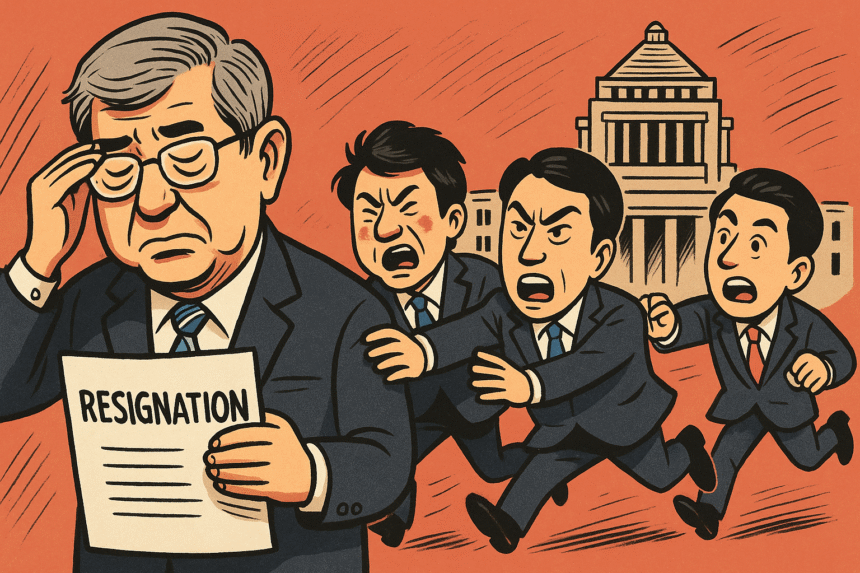
Shigeru Ishiba resigns as Japan’s PM after election losses. Here’s a witty deep dive into his exit and the leadership race ahead.
Japanese politics just hit the refresh button—again. Shigeru Ishiba, Japan’s Prime Minister, has left the building (well, technically, the Prime Minister’s office) after his party’s crushing election defeat. If politics were a Netflix drama, this would be the cliffhanger episode, complete with suspense music: “Who will be Japan’s next PM?”
Democracy in Japan just proved it loves plot twists more than your favorite K-drama.
Why Did Shigeru Ishiba Resign?
After his Liberal Democratic Party (LDP) suffered a historic loss in the July parliamentary elections, Ishiba faced mounting pressure. Party elders, critics, and even allies whispered what everyone already knew: it was time for him to bow out.
According to Reuters, Ishiba’s resignation was framed as “taking responsibility,” a hallmark of Japanese political culture. Leaders often step down not just for personal failure, but to shoulder the burden of collective disappointment. Ishiba, known for his military expertise and hawkish security stance, decided to take the honorable exit rather than drag the party further into chaos.
The Domino Effect: What Happens Next?
Ishiba’s exit has triggered a leadership race within the LDP. The winner of this internal contest won’t just get bragging rights—they’ll face a parliamentary vote to become the next Prime Minister of Japan.
But here’s the twist: the LDP, once seen as unshakeable, no longer has a guaranteed grip on power. Its ruling coalition has lost majorities in both chambers of parliament. That means the party president’s automatic promotion to PM is no longer a sure shot.
Translation: Japan’s political throne is officially up for grabs.
Who Could Be Japan’s Next PM?
The resignation has sparked feverish speculation in Tokyo’s political circles. A few names are already doing the rounds:
- Taro Kono – Popular with younger voters, outspoken, and social media-savvy. He’s been dubbed Japan’s “Twitter Politician.”
- Fumio Kishida – A known moderate with experience as foreign minister, offering a safe pair of hands.
- Opposition Candidates – For the first time in years, there’s a slim chance that an opposition leader could take the helm, given the LDP’s fragile position.
Japan watchers are now glued to every party announcement, press conference, and yes, even gossip columns. The battle isn’t just about policy; it’s about image, alliances, and who can restore public trust fastest.
Why Ishiba’s Exit Matters Beyond Japan
This isn’t just a domestic shake-up. Japan is the world’s third-largest economy (some rank it fourth depending on the metric), and its Prime Minister plays a key role in global affairs. From trade deals to security partnerships, a new face at the top could shift how Japan engages with the US, China, and the rest of the world.
In fact, as BBC News points out, political transitions in Japan often ripple far beyond Tokyo. Investors watch closely. Allies re-calculate commitments. And regional rivals? They smell opportunity.
The LDP’s Identity Crisis
The Liberal Democratic Party has dominated Japanese politics for decades. But this election defeat shows cracks in its once-impenetrable armor. Voter frustration over economic stagnation, rising living costs, and a sense of political fatigue finally boiled over.
Ishiba’s resignation symbolizes more than one leader’s fall. It’s about a party struggling to reconnect with the people. If the LDP fails to rebuild confidence, Japan may see a rare political rebalancing, with opposition forces stepping into the spotlight.
Japan’s Love Affair with Resignations
Let’s take a pause for a quirky fact: Japanese politics has a resignation culture. Leaders frequently step down after scandals, failures, or defeats. It’s seen as an honorable act, a way to take accountability.
Shigeru Ishiba’s resignation fits this tradition. But in true Japanese fashion, it also opens the door to renewal. One leader bows out; another steps in, with hopes of turning the tide.
It’s political musical chairs—except the music is taiko drums and the stakes are global.
What to Expect in the Coming Weeks
- Leadership Campaigns Begin: Expect speeches filled with promises to “restore trust,” “rebuild the economy,” and “strengthen Japan’s global standing.”
- Parliamentary Maneuvering: Without a clear LDP majority, backroom deals and alliances will decide much of the game.
- Markets on Edge: Investors hate uncertainty. The yen, stock markets, and trade outlooks may wobble until a stable government is in place.
- Public Mood: For voters, this is another test of whether politics can deliver real change—or just shuffle faces at the top.
The Global Spotlight
Remember: Japan isn’t just another country—it’s a major global player. Whoever takes Ishiba’s place will instantly step onto the world stage, dealing with security challenges, trade negotiations, and climate commitments.
Think of it this way: the world can’t afford to hit pause while Japan figures out its playlist.
A Smile-Worthy Wrap-Up
So, Shigeru Ishiba exits stage left after an election defeat, leaving Japan to wonder: who’s ready to step up and take the mic?
One thing’s for sure—the leadership race will be dramatic, messy, and possibly full of surprises. But hey, that’s democracy in action.
In Japan’s political theatre, the script may change, but the drama is always worth the ticket.
What do you think? Will the LDP hold on to power, or are we about to witness a rare opposition-led Japan? Share your thoughts, join the conversation, and don’t forget to explore more of our deep dives into global politics.
Related Post Suggestion
“Trump Lowers Tariffs on Japanese Autos: Deal or Wheel?”