





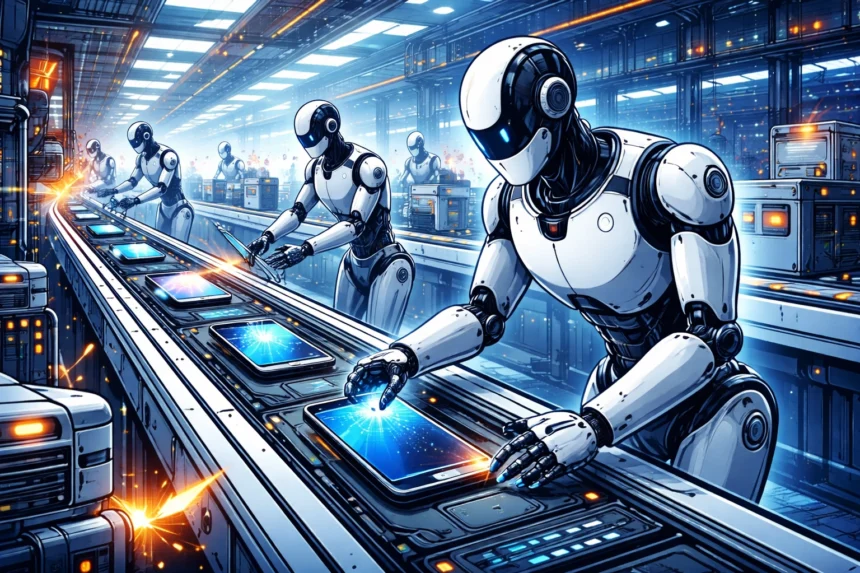
Robot factory workers are now working 24×7 in China. Is this the future of jobs or a silent disruption most people are ignoring?
- Breaking news… but not the kind that shouts.This one quietly entered your future… and sat on your chair.
- 🤖 What Exactly Happened?
- 🏭 How These Robot Factory Workers Actually Work
- 📊 The Shocking Numbers Behind Robot Factory Workers
- 🧠 The AI Twist Most People Are Ignoring
- 🔍 Why Companies Love Robot Factory Workers
- ⚠️ Will Robot Factory Workers Replace Humans?
- 🚀 The Hidden Opportunity (Most People Ignore This)
- 🇮🇳 What It Means for India
- 🧩 What You Should Do (Simple 3-Step Survival Plan)
- 🤯 The Reality Check
- ❓ FAQs on Robot Factory Workers
- 1. What are robot factory workers?
- 2. Can robots really work 24×7?
- 3. Will robots replace all jobs?
- 4. What skills are safe from automation?
- 5. Are robot factory workers already in use?
- 6. What industries will be affected most?
- 📢 So… what do you think?
- 🔗 Suggested Related Post
Breaking news… but not the kind that shouts.
This one quietly entered your future… and sat on your chair.
Imagine this:
You take a tea break.
Your replacement… doesn’t.
Welcome to the era of robot factory workers.
And here’s the punchline:
“Your next colleague might not need salary… just software updates.”
Sounds dramatic? Wait till you hear what’s already happening.
🤖 What Exactly Happened?
In a move that feels straight out of a sci-fi movie, China has deployed humanoid robot factory workers in real manufacturing units.
These are not basic machines.
These robots—developed by AGIBOT—are:
- Working 24 hours non-stop
- Performing precision tasks
- Achieving up to 99.9% accuracy
- Installed within just 36 hours
Yes, you read that right.
36 hours. Not months. Not years.
According to reports, these robots are already working in tablet manufacturing units, handling quality checks and assembly processes.
👉 And if you want to understand how automation is reshaping industries globally, even platforms like
Investopedia explains automation’s impact on jobs
highlight how machines are replacing repetitive human tasks faster than expected.
🏭 How These Robot Factory Workers Actually Work
Let’s break it down simply.
🔧 Their Job Role
These robots are deployed on tablet testing lines. Their job includes:
- Picking tablets from conveyor belts
- Fitting them into testing machines
- Checking if the product is defective
- Sorting good vs faulty products
Basically… they’re doing what humans were doing.
But here’s the twist…
⚡ Speed That Feels Unreal
- 1 tablet every 20 seconds
- Around 310 tablets per hour
- No fatigue. No breaks. No chai time.
This sounds ridiculous, but it’s real.
📊 The Shocking Numbers Behind Robot Factory Workers
Here’s where things get serious.
- Success rate: 99.9%
- Working hours: 24×7
- Setup time: 36 hours
- Error margin: Almost zero
Now compare this with human workers:
- Need rest
- Make mistakes
- Require training
- Have emotional burnout
👉 See the gap?
This is exactly why companies are quietly shifting.
🧠 The AI Twist Most People Are Ignoring
Here’s the strange part…
These robots are not just “doing” tasks.
They are learning new ones.
Earlier, factory robots were fixed machines.
Now?
- They can adapt
- They can switch tasks
- They can learn without reprogramming
That’s not automation.
That’s intelligence.
Experts are already calling this the beginning of “self-learning industrial workforce.”
🔍 Why Companies Love Robot Factory Workers
Let’s be honest. This is not charity.
Companies are making this shift because:
💰 1. Cost Efficiency
No salaries. No bonuses. No PF.
⏱️ 2. Continuous Production
Factories never stop. Output increases.
🎯 3. Precision
99.9% accuracy means fewer losses.
📉 4. Lower Human Dependency
Less hiring stress. Less management headache.
This is not just smart.
This is strategic survival.
⚠️ Will Robot Factory Workers Replace Humans?
Now the big question…
Are robots coming for your job?
Short answer:
Not all… but many.
Long answer:
- Repetitive jobs → HIGH RISK
- Creative jobs → LOW RISK
- Strategic roles → SAFE (for now)
According to multiple global workforce reports, automation could impact millions of jobs over the next decade.
But here’s the twist most people miss…
👉 Robots don’t just replace jobs.
👉 They change the type of jobs.
🚀 The Hidden Opportunity (Most People Ignore This)
While everyone is scared…
A small group is preparing.
They are learning:
- AI tools
- Automation systems
- Robotics integration
- Data analysis
Because here’s the truth:
“If you can’t beat automation… learn to control it.”
This shift will create:
- New tech jobs
- Higher-paying roles
- Skill-based opportunities
But only for those who adapt.
🇮🇳 What It Means for India
This is where things get interesting.
India is:
- A major manufacturing hub
- A growing tech powerhouse
- A large workforce economy
If robot factory workers scale globally:
👉 Indian industries will also adopt them
👉 Jobs will evolve rapidly
👉 Skill gap will widen
This is both a threat and opportunity.
And as per policy discussions highlighted in
NITI Aayog reports,
India is already focusing on AI readiness and workforce transformation.
🧩 What You Should Do (Simple 3-Step Survival Plan)
Let’s keep it practical.
1️⃣ Upgrade Skills
Learn something machines can’t easily do:
- Critical thinking
- Decision making
- Creativity
2️⃣ Learn AI Basics
You don’t need to become an engineer.
Just understand tools.
3️⃣ Stay Adaptive
The fastest learner wins.
Simple rule:
“Static mindset = obsolete career.”
🤯 The Reality Check
This isn’t future.
This is present.
Factories are already changing.
Workplaces are evolving.
And most people… are still scrolling reels.
Here’s the uncomfortable truth:
The biggest risk is not robots…
It’s ignoring them.
❓ FAQs on Robot Factory Workers
1. What are robot factory workers?
Robot factory workers are humanoid or automated machines designed to perform manufacturing tasks like assembly, testing, and packaging.
2. Can robots really work 24×7?
Yes, robots can work continuously without fatigue, only requiring maintenance or software updates.
3. Will robots replace all jobs?
No, but repetitive and low-skill jobs are at higher risk of automation.
4. What skills are safe from automation?
Creative thinking, leadership, emotional intelligence, and complex problem-solving are harder to automate.
5. Are robot factory workers already in use?
Yes, companies like AGIBOT have already deployed humanoid robots in manufacturing units.
6. What industries will be affected most?
Manufacturing, logistics, customer service, and data processing industries are most likely to see major changes.
📢 So… what do you think?
Is this innovation… or silent disruption?
Comment below 👇
Share this with your “still safe job” friend 😄
And explore more such stories before the next big shift hits.
Because by the time it becomes “breaking news”…
It’s already too late.
🔗 Suggested Related Post
👉 “Motherson Sumi Owner Net Worth Shocks Everyone”
Credit: NBT