





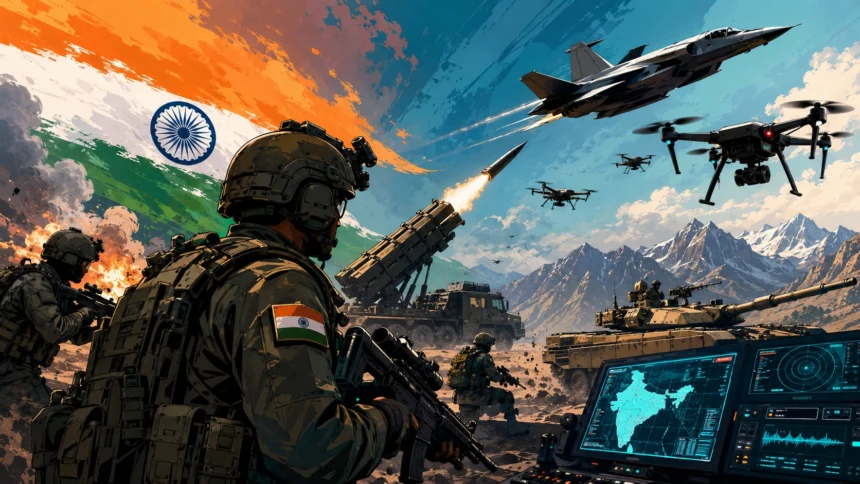
Operation Sindoor changed India’s defence strategy with drones, faster procurement, tech upgrades and a sharper war-ready mindset.
- Operation Sindoor: The 22-Minute Message
- What Operation Sindoor Revealed About Modern War
- Operation Sindoor and India’s Defence Procurement Reset
- The Hidden Lesson: Production Capacity Is Also Power
- Startups Enter the War Room
- Operation Sindoor and Atmanirbhar Defence
- Big Structural Shift: Smaller, Faster, Smarter Units
- Why Common Readers Should Care
- Operation Sindoor: The Final Takeaway
- FAQs on Operation Sindoor
- What is Operation Sindoor?
- Why is Operation Sindoor important?
- How long did Operation Sindoor last?
- What changed after Operation Sindoor?
- Why are drones important after Operation Sindoor?
- What is sensor-to-shooter timeline?
- Did Operation Sindoor support Atmanirbhar Bharat?
- Now tell us your view. Was Operation Sindoor India’s biggest defence wake-up call in recent years?
- Related Post Suggestion
Operation Sindoor – India’s 22-Minute Wake-Up Call
Breaking news, but with less shouting and more sense.
Operation Sindoor was not just a military strike. It became a giant mirror in front of India’s defence system. And the mirror said, “Boss, bravery is good, but batteries, drones, sensors and fast procurement also matter.”
The official background is serious. The operation was launched on the night of May 6–7, 2025, after the Pahalgam terror attack, according to the Press Information Bureau. The strikes hit nine terror camps in Pakistan and PoK, while India later said the action was self-defence. (Press Information Bureau)
Punchy truth? Modern war is no longer only about who fires first. It is about who upgrades fastest.
And here is the strange part. The headline numbers look cinematic: 22 minutes of strikes and 88 hours of fire exchange, as reported by The Economic Times. But the real story is not just the clock. The real story is what happened after the clock stopped. (The Economic Times)
Operation Sindoor: The 22-Minute Message
The Economic Times report says the strikes destroyed terror headquarters and hideouts in Pakistan in just 22 minutes. The firing that followed lasted 88 hours. But the bigger impact was not only military. It was structural. It forced India’s armed forces to rethink warfighting, technology, procurement and production capacity. (The Economic Times)
In simple English, India got a battlefield reminder: future conflict will not wait for file movement.
Earlier, many defence systems moved like a typical government queue. Application gaya, file chali, table badla, note laga, chai aayi, file phir gayi.
But war does not ask for “kindly process urgently.” War comes with drones, missiles, electronic warfare and surprise attacks.
That is why Operation Sindoor has become more than a military episode. It is now being treated as a defence modernisation trigger.
What Operation Sindoor Revealed About Modern War
1. Drones are not toys anymore
Once upon a time, drones were wedding video machines. Now they are battlefield scouts, strike tools and headache generators.
Operation Sindoor pushed India to focus harder on unmanned warfare. Emergency purchases were reportedly made for drones, anti-drone systems, precision weapons and secure communication equipment. (The Economic Times)
This sounds technical, but the idea is simple.
A soldier should not always have to see the enemy with his own eyes. Sensors, drones, radars and networks should see first. Then decisions should move quickly.
That is the famous “sensor-to-shooter” timeline. Meaning: detect fast, decide fast, respond fast.
In today’s battlefield, slow response is not laziness. It is risk.
2. Anti-drone systems became VIP guests
If drones are the new problem, anti-drone systems are the new security guards.
PIB’s Defence Ministry year-end review stated that on May 10, 2025, Pakistan launched attacks using missiles, drones, rockets and long-range weapons, but Indian air defence, counter-drone systems and electronic equipment thwarted the attack. (Press Information Bureau)
That one line tells a big story.
The future battlefield may look less like an old war movie and more like a tech expo with danger attached. Drones flying. Jammers working. Radars tracking. Command centres processing. Soldiers executing.
Most people ignore this hidden truth: the country with better networks may beat the country with bigger noise.
Operation Sindoor and India’s Defence Procurement Reset
Here comes the most unglamorous but important part: procurement.
Yes, procurement. That sleepy word that can decide whether soldiers get modern tools on time or after the threat has already changed its hairstyle.
According to The Economic Times, in the year after Operation Sindoor, the defence ministry cleared procurement worth ₹6.81 lakh crore, compared with ₹1.76 lakh crore in the year before. These included unmanned fighters, stealth warships, long-range air defence systems, precision attack drones, low-cost anti-drone systems, space-based assets and indigenous missiles. (The Economic Times)
That is not a small jump. That is a “file ne protein shake pi liya” moment.
Why speed matters
The old-school procurement cycle could take years. A requirement would be floated, vendors would compete, contracts would be signed, supplies would begin much later.
In peaceful times, this looks like procedure. In conflict, it looks like a problem.
The ET report notes that new rules are aimed at trimming timelines so armed forces can get required weapons 30–50% faster, with urgent purchases possible within six months and deliveries targeted within two years. (The Economic Times)
This is a huge shift.
The new mantra is clear: build faster, test faster, buy faster, deploy faster.
The Hidden Lesson: Production Capacity Is Also Power
Here is the part most people don’t know.
Weapons are not only about quality. They are also about quantity and refill speed.
A missile may be brilliant. A drone may be deadly. But what happens if the conflict stretches for weeks?
Operation Sindoor reportedly made planners focus on surge production capacity. The plan is to build long-term contracts with Indian industry so companies can create excess production capacity, especially for ammunition and drones. The larger goal mentioned in the report is to keep stocks sufficient for at least 40 days of intense conflict, with 60 days as the target. (The Economic Times)
That is the real insider lesson.
A country does not only need weapons. It needs factories that can keep feeding the battlefield.
In cricket language, this is not just about having a star batsman. It is about having a deep bench, extra bats, extra gloves and a physio who does not panic.
Startups Enter the War Room
This is where the story becomes very 2026.
Private defence companies and startups are no longer sitting outside the gate waiting for permission slips. Reports indicate that after Operation Sindoor, private sector companies were embedded with active combat units, working on real-time feedback to upgrade drones and communication equipment. (The Economic Times)
That is a big cultural change.
Earlier: “Submit proposal.”
Now: “Test it. Fix it. Improve it. Bring it back.”
NDTV reported that India’s defence ecosystem is expanding with registered drones, remote pilot certificates, training organisations and reduced regulatory steps. It also reported that counter-drone systems have become a key priority and that the anti-drone market may grow 5–10 times in the coming years. (www.ndtv.com)
This is not just defence news. This is startup news, manufacturing news and national security news wearing the same jacket.
Operation Sindoor and Atmanirbhar Defence
Operation Sindoor also gave a boost to the “Atmanirbhar defence” idea.
DRDO-linked material notes the use of Indian systems such as Akash missile systems, counter-drone technology and Man Portable Counter Drone Systems to jam and disable hostile UAVs. It also mentions loitering munitions and precision strike systems as part of the modern warfare picture.
Now, let’s decode this without defence jargon.
India wants to reduce dependence on foreign suppliers. Because in a crisis, import dependence can become a pressure point.
Imagine needing urgent equipment and hearing, “Delivery expected in 18 months.”
That is not defence. That is customer care trauma.
So the focus is shifting to Indian manufacturing, Indian startups, Indian testing and Indian intellectual property.
This does not mean foreign partnerships disappear. It means India wants more control over its own defence shelf.
Big Structural Shift: Smaller, Faster, Smarter Units
The article reference also mentions structural changes in combat units.
The idea is simple. Future conflicts may need compact, mobile, networked units instead of slow, heavy formations.
The Army has reportedly been moving toward new formations such as Rudra brigades, Bhairav battalions and Ashni platoons. These are expected to integrate infantry, armour, artillery, drones and logistics for faster operations.
Think of it like changing from an old bulky desktop to a powerful laptop.
Same seriousness. More mobility.
The goal is speed, coordination and decentralised combat power.
Why Common Readers Should Care
Some readers may ask: “Bhai, I am not in defence. Why should I care?”
Because national security is not only a border story. It affects technology, startups, jobs, manufacturing, diplomacy and even the economy.
When India spends more on domestic defence manufacturing, new factories come up. Engineers get work. Drone companies grow. Electronics firms get orders. Small manufacturers enter the supply chain.
In other words, one defence lesson can create a whole industrial ecosystem.
And yes, it also tells citizens one important thing: future wars will be fought by soldiers, but supported by scientists, coders, engineers, factories and startups.
The battlefield has gone full team project.
Operation Sindoor: The Final Takeaway
Operation Sindoor was not just about 22 minutes and 88 hours.
It was about what India learned after those hours.
It revealed that modern defence needs speed, drones, anti-drone systems, precision weapons, secure communication, faster procurement, domestic manufacturing and smarter military structures.
The old model was: prepare, procure, deploy.
The new model is: detect, adapt, build, test, deploy, upgrade.
That is the hidden story.
Operation Sindoor showed that India’s defence future will not be written only in bravery. It will also be written in code, sensors, factories, drones and faster decisions.
And honestly, that is the upgrade button India cannot afford to ignore.
FAQs on Operation Sindoor
What is Operation Sindoor?
Operation Sindoor was India’s military operation launched on the night of May 6–7, 2025, after the Pahalgam terror attack.
Why is Operation Sindoor important?
Operation Sindoor is important because it changed India’s focus toward drones, anti-drone systems, faster procurement and modern defence technology.
How long did Operation Sindoor last?
Reports say the initial strikes took 22 minutes, while the exchange of fire lasted around 88 hours.
What changed after Operation Sindoor?
India accelerated defence modernisation, emergency procurement, unmanned warfare capability and domestic production planning.
Why are drones important after Operation Sindoor?
Drones are important because they help in surveillance, precision strikes and faster battlefield response without putting soldiers directly at risk.
What is sensor-to-shooter timeline?
Sensor-to-shooter timeline means the time taken to detect a threat, process information and respond with the right weapon.
Did Operation Sindoor support Atmanirbhar Bharat?
Yes. Operation Sindoor strengthened the focus on Indian-made defence systems, domestic manufacturing and startup participation.
Now tell us your view. Was Operation Sindoor India’s biggest defence wake-up call in recent years?
Drop your thoughts in the comments, share this before the next “breaking news” siren starts screaming, and explore more Nokjhok explainers for news without headache.
Related Post Suggestion
India-Bangladesh Siliguri Corridor: The Big Rail Move
Credit: The Economic Times