





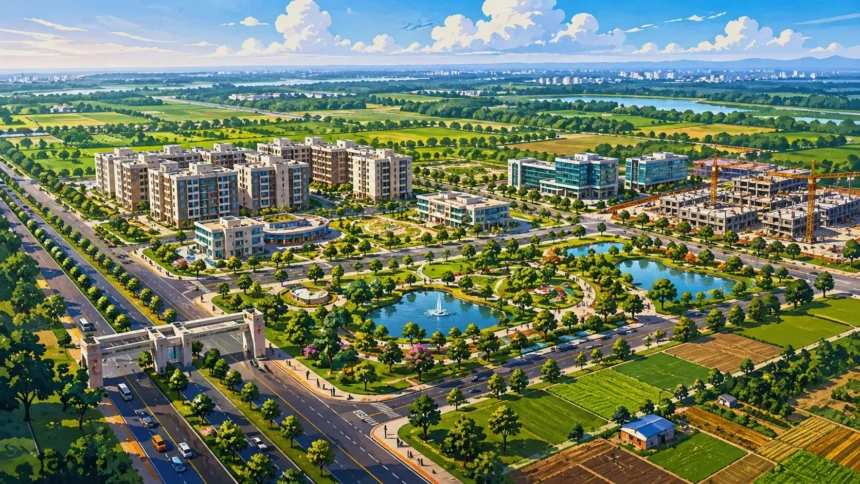
Bihar Satellite Township plan may transform 11 cities with core zones, special areas and land pooling. Here’s the hidden urban story.
- What Is The Bihar Satellite Township Plan?
- Why Bihar Satellite Township Is Trending Now
- Core Area And Special Zone: What Do These Mean?
- Which Cities Are Included In Bihar Satellite Township?
- The Land Pooling Model: The Real Game-Changer
- Why 55% Developed Land Matters
- Why The Core Area Will Be Developed First
- What Facilities Can Come In These Satellite Townships?
- Why Bihar Needs Satellite Townships
- The Real Estate Angle: Opportunity Or Overhype?
- What Farmers Should Watch Carefully
- The Hidden Risk: Execution
- What Experts Are Quietly Noticing
- Bihar Satellite Township: The Nokjhok Reality Check
- Final Verdict: Bihar Has A Big Urban Chance
- FAQs On Bihar Satellite Township
- 1. What is Bihar Satellite Township?
- 2. How many satellite townships will be built in Bihar?
- 3. What is the land pooling model in Bihar township plan?
- 4. How much developed land will farmers get back?
- 5. What are core area and special zone?
- 6. Can people buy land in these township areas now?
- 7. Why is Bihar Satellite Township important?
- Related Post Suggestion
11 Cities Get A Mega Plan
Breaking news from Bihar’s future city department: the state is not just planning new roads, bridges, and buildings anymore.
It is planning full satellite townships.
Yes, proper planned urban zones.
Not “plot le lo, baad mein road dekh lenge” type development.
Not “colony ka naam Green Valley, but green sirf brochure mein” type setup.
The Bihar Satellite Township plan aims to develop 11 new satellite townships near major cities using a land-pooling model. As per reports, the government wants to return 55% of developed land to landowners after development. For official urban development context, Bihar’s Urban Development and Housing Department is the key department connected with such city planning work.
One-liner alert: Bihar is trying to turn empty green fields into planned city zones—without making planning itself disappear like streetlights during voltage drop.
What Is The Bihar Satellite Township Plan?
The Bihar Satellite Township plan is a major urban development blueprint under which the state government plans to develop new satellite townships around 11 major cities.
According to reports, these townships will be developed as planned urban areas with roads, civic facilities, housing, commercial areas, institutions, green zones, and better connectivity.
The big idea is simple.
Instead of letting cities grow randomly like WhatsApp rumours, the government wants to create structured townships near existing urban centres.
That means future growth can be shifted into planned zones rather than choking the old city areas.
And honestly, many Bihar cities need this.
Because in several towns, one narrow road handles school traffic, market traffic, marriage procession traffic, cow traffic, political rally traffic, and uncle-on-bike traffic—all at the same time.
Why Bihar Satellite Township Is Trending Now
The Bihar Satellite Township plan is trending because the government has started preparing the blueprint for these townships.
NBT reported that Bihar’s Urban Development Department has marked core areas and special zones for the project. The core areas will be developed first because they are largely vacant, greenfield spaces with fewer existing structures. This can make land transfer and planned development easier. (Navbharat Times)
Reports also mention that 11 satellite townships will be developed through a land-pooling framework under the Town Planning Scheme, and landowners may receive 55% of developed land back after development. (ETRealty.com)
This is where the story gets interesting.
The government is not just saying, “Give us land.”
It is saying, “We will develop the area and return a major portion of developed land to you.”
That is the main twist.
Core Area And Special Zone: What Do These Mean?
The plan divides township land into two broad parts: core area and special zone.
Core Area
The core area is the priority development zone.
This is usually vacant or largely undeveloped land where there are fewer permanent structures. That means development can begin faster, with fewer disputes and fewer obstacles.
Think of it as the “start here” zone.
Roads, layouts, basic infrastructure, plots, and public facilities may be created first in this part.
Special Zone
The special zone is usually bigger and may include areas around the core zone.
Development here may happen later or in phases. Once the core area is developed, nearby special zones may start seeing automatic growth due to rising demand, better roads, and improved infrastructure.
In simple words, the core area is the engine.
The special zone is the trailer.
If the engine works, the trailer also moves.
Which Cities Are Included In Bihar Satellite Township?
The project is expected around 11 cities.
Based on the available details, the cities and proposed township locations include:
Patna – Partaliputra
Gaya – Magadh
Sonepur – Hariharnathpur
Darbhanga – Mithila
Saharsa – Kosi
Purnia – Purnia
Munger – Ang
Muzaffarpur – Tirhut
Chhapra – Saran
Bhagalpur – Vikramshila
Sitamarhi – Sitapuram
These names are not just decorative labels. They may become the identity of future planned urban zones.
For example, Patna’s proposed township area is near Bihta-Sarmera Road and around Patna Junction or airport connectivity zones mentioned in the reference. Gaya’s Magadh township is placed near Gaya-Dobhi Road, with distance references from Gaya Junction and airport.
This shows one important thing: connectivity is central to the plan.
Because a township without connectivity is just expensive land with good intentions.
The Land Pooling Model: The Real Game-Changer
Now let us decode the most important part: land pooling.
In normal land acquisition, government takes land and pays compensation.
In land pooling, landowners pool their land into a development project. The government or planning authority then creates roads, drains, parks, plots, utilities, and other infrastructure. After development, part of the developed land is returned to original owners.
For the Bihar Satellite Township plan, reports say the government may return 55% of developed land to farmers or landowners. (Navbharat Times)
This sounds technical, but the benefit is simple.
A farmer may give raw land.
The government develops it.
The farmer gets back a smaller but developed plot.
That developed plot may have a much higher market value.
This is why officials are calling it a partnership-style model.
Why 55% Developed Land Matters
The number 55% is important.
Reports say landowners will get 55% of developed land back. Some reports also mention that the remaining land may be used for roads, infrastructure, parks, public facilities, housing for weaker sections, and cost recovery. (Navbharat Times)
This is the hidden math behind planned cities.
A township needs roads.
It needs drainage.
It needs parks.
It needs schools.
It needs utilities.
It needs public spaces.
It needs commercial areas.
All this cannot be created without using part of the land.
So the government keeps some land for infrastructure and planned development, while returning a developed share to the original landowners.
If implemented fairly, this can reduce conflict and increase participation.
But if communication is weak, confusion can spread faster than election exit polls.
Why The Core Area Will Be Developed First
The government appears to be prioritising core areas because they are largely empty and undeveloped.
This makes sense.
If a place already has many homes, shops, temples, schools, and local networks, development becomes difficult. You have to handle rehabilitation, objections, legal issues, and political pressure.
But if the core area is mostly vacant, the planning team can work faster.
Reports suggest the government believes core-area development will also trigger development in nearby special zones. (Navbharat Times)
In simple language, build the main skeleton first.
Then the surrounding body will grow.
What Facilities Can Come In These Satellite Townships?
A good satellite township is not just plots and buildings.
It should include:
Wide internal roads
Drainage and sewerage systems
Power and water supply
Parks and open spaces
Schools and institutions
Healthcare facilities
Commercial areas
Residential pockets
Public transport access
Street lighting
Digital infrastructure
Parking zones
Green buffers
Here’s the strange part: citizens often notice buildings first, but the real quality of a township depends on what they do not see.
Drainage.
Water lines.
Road width.
Traffic exits.
Plot layout.
Sewage planning.
Because nobody wants a “world-class township” where one monsoon converts the entrance road into a surprise river cruise.
Why Bihar Needs Satellite Townships
Bihar’s cities are growing fast, but urban planning has often struggled to match population pressure.
Old city areas are crowded. Traffic is increasing. Housing demand is rising. Young people need better jobs. Businesses need organised spaces. Families want cleaner and safer residential layouts.
The Bihar Satellite Township plan can help by creating new planned growth zones outside congested city centres.
This can bring three direct benefits:
1. Less Pressure On Existing Cities
If new housing and commercial demand moves into planned satellite zones, old city areas may get some breathing space.
2. Better Real Estate Planning
Instead of unplanned colonies, buyers may get plotted development with roads, drainage, parks, and clear layouts.
3. Local Job Creation
Construction, retail, transport, maintenance, shops, institutions, healthcare, and services can create jobs around these townships.
The Real Estate Angle: Opportunity Or Overhype?
Now comes the masala section.
Whenever a new township is announced, real estate discussions become hotter than summer tea in Patna.
People ask:
Should we buy nearby land?
Will prices rise?
Which location is best?
Will builders enter?
Can farmers benefit?
Will investors make money?
The answer is: maybe, but with caution.
Reports say sale, purchase, transfer, and new construction in identified areas may be restricted until master plans are notified, possibly up to 2027 in some cases. (Navbharat Times)
So this is not the time for blind WhatsApp-investing.
Before buying anything near these proposed zones, people should check official notifications, restrictions, land records, title status, and project approvals.
Because in real estate, the sentence “township aa raha hai” has made many people both rich and regretful.
What Farmers Should Watch Carefully
The land-pooling model can be beneficial, but farmers and landowners should understand the terms clearly.
They should check:
How much land will be pooled
What exact developed share will return
Where the returned plot will be located
When development will finish
Who pays which charges
Whether compensation is also involved
How disputes will be handled
Whether land records are clean
What happens if the project is delayed
This is important because land is not just an asset. It is emotion, security, family history, and future wealth.
A strong model must protect landowners, not confuse them.
The Hidden Risk: Execution
Now the warning.
The Bihar Satellite Township plan sounds ambitious, but execution will decide everything.
Planning is easy on paper.
Implementation is where the real exam starts.
The government must handle:
Land pooling consent
Master plan preparation
Farmer communication
Infrastructure funding
Environmental balance
Drainage and water planning
Transparent allotment
Developer participation
Road connectivity
Time-bound execution
If these are handled well, Bihar can create a new model for planned urban expansion.
If handled poorly, the project may become another file sleeping peacefully inside an office cupboard.
What Experts Are Quietly Noticing
Urban planners are increasingly focusing on satellite townships because old cities cannot keep absorbing unlimited population pressure.
India’s urban population is rising, and planned peripheral development is becoming important for housing, jobs, and infrastructure. Satellite townships can work when they are linked properly with roads, railways, airports, and economic activity.
That is why connectivity details matter.
Many proposed Bihar townships are being discussed in relation to highways, railway stations, airports, bypass roads, and expressways.
That is not a coincidence.
Connectivity turns land into location.
Bihar Satellite Township: The Nokjhok Reality Check
Let us say it clearly.
This plan has potential.
But citizens should not judge it only by AI images, political statements, or fancy names.
They should track real milestones:
Official notification
Master plan release
Land pooling terms
Farmer consent process
Infrastructure timeline
Road connectivity plan
Plot return mechanism
Project phase schedule
Public grievance system
Because a city is not built by headline.
A city is built by boring approvals, honest execution, and drains that actually work.
Final Verdict: Bihar Has A Big Urban Chance
The Bihar Satellite Township plan could become one of the state’s most important urban development moves.
If 11 satellite townships are developed properly, Bihar may get better-planned growth, more organised real estate, improved civic infrastructure, and new economic zones.
The 55% developed land return model can also make farmers partners in growth instead of just land losers.
But the success will depend on transparency, execution, and timely delivery.
So yes, Bihar may be preparing for a major urban glow-up.
Now the only request is: please make it planned, green, well-connected, and not another “future smart city” where the future never reaches.
Comment your thoughts, share this with someone tracking Bihar real estate, and explore more Nokjhok infrastructure stories before the next mega project arrives in your WhatsApp family group with “100% confirmed” written on it.
Forward this before Arnab screams it on TV.
FAQs On Bihar Satellite Township
1. What is Bihar Satellite Township?
Bihar Satellite Township is a state urban development plan to create 11 planned townships near major cities in Bihar.
2. How many satellite townships will be built in Bihar?
Reports say Bihar plans to develop 11 satellite townships near major cities.
3. What is the land pooling model in Bihar township plan?
Under land pooling, landowners pool raw land for development and may receive a share of developed land back after infrastructure is created.
4. How much developed land will farmers get back?
Reports say the government plans to return 55% of developed land to farmers or landowners.
5. What are core area and special zone?
The core area is the priority zone that will be developed first. The special zone is the surrounding larger zone that may grow later in phases.
6. Can people buy land in these township areas now?
Reports suggest land sale, transfer, and new construction may be restricted in identified areas until master plans are notified.
7. Why is Bihar Satellite Township important?
It can reduce pressure on old cities, create planned urban spaces, improve infrastructure, generate jobs, and boost land value.
Related Post Suggestion
Ghaziabad Aerocity Project: NCR’s Next Big Glow-Up?
Credit: NBT