





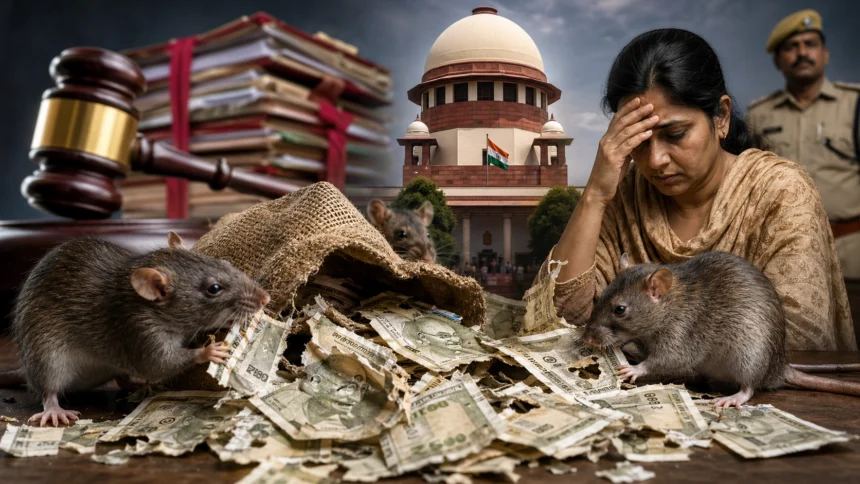
Rats Ate Bribe Money: Supreme Court grants bail in Bihar bribery case after shock over claim that seized cash was destroyed.
- India’s Most Unexpected Courtroom Plot Twist
- What Is the Rats Ate Bribe Money Case?
- Why Did the Supreme Court Get Surprised?
- The Core Legal Issue: Evidence Handling
- What Was the Allegation Against Aruna Kumari?
- Why the Rat Claim Became a National Talking Point
- Supreme Court’s Relief: What Exactly Happened?
- What Makes This Case Serious Beyond the Meme?
- Prevention of Corruption Act: Why It Matters
- The Bigger Question: Can Destroyed Evidence Still Support Conviction?
- What Experts Are Quietly Noticing
- 1. Supreme Court’s View on Evidence Preservation
- 2. Corruption Case Standards
- 3. Administrative Accountability
- Why This Story Is Meme-Worthy But Not Light
- Final Take: The Courtroom Rat Twist Is Not Over
- 1. What is the Rats Ate Bribe Money case?
- 2. Who is Aruna Kumari?
- 3. What did the Supreme Court do?
- 4. What did Patna High Court decide earlier?
- 5. Why is the missing bribe money important?
- 6. Does bail mean Aruna Kumari is acquitted?
- 7. Why did this case become viral?
- What do you think—was this poor evidence handling, a weak prosecution story, or India’s most unexpected courtroom twist?
- Suggested Related Post
India’s Most Unexpected Courtroom Plot Twist
Breaking news from the legal universe.
Not a political rally.
Not a Bollywood courtroom scene.
Not even a crime thriller.
This time, the headline belongs to… rats.
Yes, you read that right.
In a Bihar corruption case, the Supreme Court was told that seized bribe money was destroyed by rodents. The court granted bail to a woman convicted under the Prevention of Corruption Act and suspended her sentence while questioning this unusual claim. (Live Law)
One-line truth: In India, sometimes even evidence needs pest control.
Welcome to the strange, serious, and very meme-worthy story of Rats Ate Bribe Money.
What Is the Rats Ate Bribe Money Case?
The case involves Aruna Kumari, a Bihar government employee who reportedly worked as a Child Development Project Officer. She was accused of demanding a bribe of ₹10,000. A corruption case was filed against her under the Prevention of Corruption Act, 1988. (www.ndtv.com)
Now here is where the legal journey becomes interesting.
The trial court initially acquitted her. But later, the Patna High Court reversed the acquittal, convicted her, and sentenced her to imprisonment under corruption law provisions. The Supreme Court order notes that she was sentenced to four years rigorous imprisonment under Section 13(2) and three years rigorous imprisonment under Section 7 of the Prevention of Corruption Act. (Indian Kanoon)
Then the matter reached the Supreme Court.
And the court noticed something that made even judges pause:
The seized currency notes were reportedly not available because they were destroyed by rodents.
That is not a legal sentence.
That is a full-blown screenplay idea.
Why Did the Supreme Court Get Surprised?
The Supreme Court bench of Justice J.B. Pardiwala and Justice K.V. Viswanathan expressed surprise over the claim that seized currency notes had been destroyed by rodents. Reports say the court found it difficult to trust the explanation that such crucial evidence disappeared in this manner. (Live Law)
And honestly, the reaction is understandable.
Because in a corruption case, seized cash is not a casual grocery bill.
It is key evidence.
If the allegation is that someone took a bribe, then the recovered currency notes can become very important. The notes may help prove trap proceedings, recovery, serial numbers, handling, and the chain of evidence.
So when the court hears that the money was destroyed by rats, the question naturally becomes:
Were the rats unusually powerful?
Or was the evidence unusually poorly protected?
The Core Legal Issue: Evidence Handling
This case is not funny only because of the rat angle.
Behind the meme is a serious legal issue:
How was crucial evidence stored?
In criminal and corruption cases, evidence must be preserved carefully. If seized material disappears, gets damaged, or is not produced properly, it can weaken the prosecution’s case.
Here’s the strange part.
The Patna High Court still convicted Aruna Kumari despite the physical currency notes not being produced in usable form. The Supreme Court has now decided to examine the matter more closely and has suspended the sentence for the time being. (Indian Kanoon)
This means the final word is not yet fully written.
The Supreme Court has not said she is innocent.
It has not fully decided the appeal.
It has simply granted relief at this stage by suspending the sentence and granting bail.
That difference matters.
What Was the Allegation Against Aruna Kumari?
According to reports, Aruna Kumari was accused of demanding and accepting a bribe of ₹10,000. The case was filed under the Prevention of Corruption Act. The trial court acquitted her, but the Patna High Court later reversed that decision and convicted her. (www.ndtv.com)
In corruption cases, courts usually look at two big questions:
1. Was there demand for bribe?
Demand is a crucial ingredient in many bribery cases.
2. Was there acceptance or recovery?
If money is recovered, it can support the prosecution story.
But if recovered money disappears, the case becomes complicated.
Because then the court has to rely on other materials such as witness statements, trap records, registers, seizure memos, chemical test reports, and procedural documents.
This is exactly why the “rats ate the money” point became so important.
Why the Rat Claim Became a National Talking Point
Let’s be honest.
The internet loves unusual court stories.
A regular corruption case may not go viral.
But “rats ate bribe money” is headline gold.
It has everything:
- Corruption angle
- Bihar angle
- Courtroom drama
- Missing evidence
- Rodents as unexpected characters
- Supreme Court surprise
This sounds funny, but it also raises a harsh question:
If seized cash can vanish like this, how many other cases may suffer because evidence is not stored properly?
The Supreme Court reportedly expressed concern over how many such currency notes may get destroyed if kept in unsafe places. (Verdictum)
That one concern turns a funny headline into a serious governance issue.
Supreme Court’s Relief: What Exactly Happened?
The Supreme Court granted bail to Aruna Kumari and suspended her sentence pending further hearing. The court order also records that leave was granted, meaning the appeal will now be considered by the Supreme Court. (Indian Kanoon)
In simple English:
She does not have to undergo the sentence right now.
The case will be examined further.
The conviction issue is not finally over.
This is important because headlines can confuse readers.
“Bail granted” does not mean “case finished.”
“Sentence suspended” does not mean “conviction erased.”
It means the Supreme Court has paused the punishment while it studies the matter.
Legal cinema interval hai, climax baaki hai.
What Makes This Case Serious Beyond the Meme?
Let’s move beyond comedy.
This case touches three major issues.
1. Chain of Custody
Evidence must travel from seizure to court safely. Every step must be recorded.
2. Public Trust
People expect corruption cases to be handled with seriousness.
3. Storage of Seized Property
Cash, documents, weapons, digital devices, and other materials must be protected properly.
If evidence is casually stored, then both sides suffer.
The prosecution loses credibility.
The accused may face uncertainty.
The justice system looks careless.
That is why this case is not merely “rats did something funny.”
It is about whether the system protects evidence properly.
Prevention of Corruption Act: Why It Matters
The case falls under the Prevention of Corruption Act, 1988, which is India’s main law to punish public servants involved in bribery and corruption.
The Act is meant to protect public life from bribery, misuse of office, and illegal gratification.
But corruption cases need strong proof.
A person cannot be convicted only because suspicion exists. The prosecution must prove the legal ingredients through reliable evidence.
So when key evidence is missing, destroyed, or not produced, courts naturally become cautious.
This is not sympathy.
This is due process.
And due process is the oxygen of criminal justice.
The Bigger Question: Can Destroyed Evidence Still Support Conviction?
Yes, sometimes.
A conviction may still stand even if physical evidence is not available, provided other evidence is strong enough.
For example:
- Witness testimony
- Trap team evidence
- Recovery memos
- Official records
- Chemical test proof
- Independent corroboration
But here is the challenge:
If the missing evidence is central to the case, the court must be extra careful.
In this case, the Supreme Court has shown that it wants to examine whether the Patna High Court was right in relying on other materials despite the missing or destroyed currency notes.
That is the real courtroom battle.
Not rats vs notes.
Evidence vs doubt.
What Experts Are Quietly Noticing
Legal observers are likely watching three things.
1. Supreme Court’s View on Evidence Preservation
The court may make important observations on how seized currency should be stored.
2. Corruption Case Standards
The case may clarify how much weight courts can give to documentary records when physical bribe money is missing.
3. Administrative Accountability
If evidence is destroyed due to poor storage, someone must answer.
Because if rats can destroy key evidence today, tomorrow someone may claim termites ate a land record, monkeys stole a file, or humidity swallowed a hard disk.
At some point, the system has to say: enough comedy.
Why This Story Is Meme-Worthy But Not Light
The phrase Rats Ate Bribe Money is funny.
But the consequences are not.
A corruption conviction affects someone’s liberty, reputation, career, and future.
At the same time, weak evidence handling can damage public trust in anti-corruption enforcement.
So this story has two sides:
Funny headline.
Serious institution-level question.
And that is exactly why it has gone viral.
Because it makes people laugh first… and then think.
Final Take: The Courtroom Rat Twist Is Not Over
The Rats Ate Bribe Money case is one of those rare legal stories where satire and seriousness sit on the same bench.
A Bihar government employee was convicted in a bribery case. The trial court had acquitted her, the Patna High Court convicted her, and now the Supreme Court has suspended the sentence and granted bail while questioning the claim that seized currency notes were destroyed by rodents.
The final legal outcome will come later.
But the bigger message is already clear:
Evidence must be protected.
Corruption cases must be strong.
And if rats become part of the prosecution story, courts will ask questions.
Because in justice, even ₹10,000 cannot simply disappear into a mouse hole.
FAQs
1. What is the Rats Ate Bribe Money case?
It is a Bihar corruption case where seized bribe money was reportedly destroyed by rodents, leading to Supreme Court concern.
2. Who is Aruna Kumari?
Aruna Kumari is a Bihar government employee accused in a ₹10,000 bribery case under the Prevention of Corruption Act.
3. What did the Supreme Court do?
The Supreme Court suspended her sentence and granted bail while agreeing to examine the case further.
4. What did Patna High Court decide earlier?
The Patna High Court reversed the trial court’s acquittal and convicted Aruna Kumari in the corruption case.
5. Why is the missing bribe money important?
Seized currency notes can be crucial evidence in proving demand, acceptance, recovery, and trap proceedings.
6. Does bail mean Aruna Kumari is acquitted?
No. Bail and sentence suspension do not mean final acquittal. The appeal is still pending.
7. Why did this case become viral?
The claim that rats destroyed seized bribe money made the case unusual, meme-worthy, and legally serious.
What do you think—was this poor evidence handling, a weak prosecution story, or India’s most unexpected courtroom twist?
Comment your view, share this with your legally curious friend, and explore more decoded news on Nokjhok.com.
Forward this before Arnab starts a prime-time debate: “Are rats weakening anti-corruption law?”
Suggested Related Post
“Luxury Wedding Cake: ₹22 Lakh Surprise Everyone”
Credit: NBT