





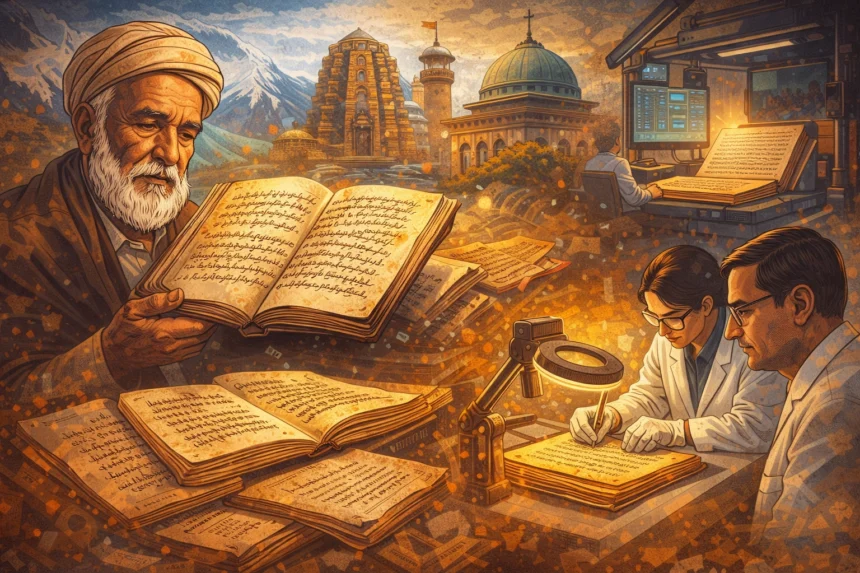
Gyan Bharatam Mission uncovers 40,000 manuscripts in J&K. Discover the hidden cultural treasure India is quietly preserving.
- India Just Found 40,000 Hidden Stories
- 🧠 What Is the Gyan Bharatam Mission?
- 📚 40,000 Manuscripts: Why This Is a Big Deal
- 🔍 The Hidden Truth: Why These Manuscripts Matter
- 🧩 The Colonial Twist Nobody Talks About
- ⚙️ How the Mission Actually Works
- 🧠 Insider Insight: What Experts Are Quietly Saying
- 📊 Numbers That Will Surprise You
- ⚠️ The Risk Nobody Is Talking About
- 🌍 Why This Matters Globally
- 🤯 The Unexpected Angle: Knowledge Is Power
- 🔮 What Happens Next?
- 🧠 Final Thought: India’s Silent Knowledge Revolution
- ❓ FAQs
- 1. What is the Gyan Bharatam Mission?
- 2. How many manuscripts were found in J&K?
- 3. What is special about these manuscripts?
- 4. Are manuscripts taken from owners?
- 5. Why are manuscripts important?
- 6. Where are manuscripts stored?
- 7. Can the public access them?
- 📢 Did you know India had millions of hidden manuscripts?
- 🔗 Related Post
India Just Found 40,000 Hidden Stories
Something unbelievable just happened.
No, not another election drama.
Something quieter… but far more powerful.
40,000 manuscripts.
Hidden for centuries.
Now suddenly… discovered.
Sounds like a Netflix documentary?
Nope. This is real India.
👉 One-line truth:
India didn’t just find old books — it found lost memory.
Under the Gyan Bharatam Mission, thousands of ancient manuscripts have been identified in Jammu & Kashmir. And here’s the shocking part — many of these are hundreds of years old.
According to
Ministry of Culture, Government of India, preserving manuscripts is key to protecting India’s knowledge systems — from philosophy to science.
But this story is deeper than headlines.
Let’s decode what’s really happening.
🧠 What Is the Gyan Bharatam Mission?
The Gyan Bharatam Mission is not just a government project.
It’s more like a cultural rescue operation.
Launched with the goal of:
- Identifying ancient manuscripts
- Preserving traditional knowledge
- Digitizing rare texts
- Creating a national knowledge archive
And now, Jammu & Kashmir has become the center of attention.
📚 40,000 Manuscripts: Why This Is a Big Deal
Let’s break it down.
👉 Over 40,000 manuscripts have been identified in J&K.
Not printed books.
Not PDFs.
Actual handwritten documents.
Some key highlights:
- One manuscript in Takri script from the 16th century
- Rare Persian and Sanskrit texts
- Documents covering history, poetry, and philosophy
Now here’s the crazy part:
👉 Many of these were lying in remote areas, unknown to the public.
🔍 The Hidden Truth: Why These Manuscripts Matter
You might wonder — why should you care?
Because these manuscripts are not just “old papers”.
They are:
- Historical records
- Scientific knowledge
- Cultural identity
Think about it.
Before Google, before textbooks…
This was how knowledge was stored.
And India has millions of such manuscripts — many still undiscovered.
🧩 The Colonial Twist Nobody Talks About
Here’s where things get uncomfortable.
A senior official revealed:
👉 Many manuscripts and antiques were taken away during British rule.
Yes.
India didn’t just lose wealth.
It lost knowledge.
This sounds dramatic, but it’s true.
Experts estimate that thousands of Indian manuscripts are still in foreign museums.
According to
British Museum archives, several South Asian artifacts remain preserved abroad.
So this mission is not just about discovery.
👉 It’s about reclaiming identity.
⚙️ How the Mission Actually Works
This isn’t a random search operation.
There’s a system behind it.
Step 1: Survey
Officials visit remote regions and identify manuscripts.
Step 2: Documentation
Details are recorded — language, age, condition.
Step 3: Owner Permission
Manuscripts are not taken forcibly.
Owners retain control.
Step 4: Digitization
Texts are scanned and stored digitally.
Step 5: Preservation
Special labs are used to protect fragile materials.
This sounds simple.
But imagine handling a 400-year-old document.
One mistake — gone forever.
🧠 Insider Insight: What Experts Are Quietly Saying
Historians are excited.
Why?
Because this discovery could:
- Rewrite local histories
- Reveal unknown authors
- Provide insights into ancient sciences
Some insiders believe:
👉 This could be India’s biggest knowledge archive project in decades.
And here’s the twist:
Most people are still not paying attention.
📊 Numbers That Will Surprise You
Let’s put things in perspective:
- India has an estimated 5 million manuscripts
- Only a fraction has been digitized
- J&K alone contributed 40,000+ discoveries
Now think about that.
👉 We’re just scratching the surface.
⚠️ The Risk Nobody Is Talking About
Here’s the dark side.
Manuscripts are extremely fragile.
- Paper decays
- Ink fades
- Climate damages material
And here’s the scary part:
👉 Thousands of manuscripts are lost every year.
That’s why this mission is urgent.
🌍 Why This Matters Globally
This isn’t just India’s story.
Global scholars are watching.
Because these manuscripts can:
- Add to world history
- Reveal trade and cultural exchanges
- Show India’s influence in global knowledge systems
In simple terms:
👉 This is not just heritage. It’s global intellectual property.
🤯 The Unexpected Angle: Knowledge Is Power
Here’s something most people ignore.
Countries don’t just compete economically.
They compete culturally.
And knowledge is power.
By preserving manuscripts, India is:
- Strengthening identity
- Building academic influence
- Creating future research opportunities
This sounds big.
Because it is.
🔮 What Happens Next?
Here’s what to watch:
1. Digitization Speed
How fast can these manuscripts be preserved?
2. Public Access
Will these be available online?
3. Academic Research
New discoveries could change textbooks.
4. Global Collaboration
Foreign universities may get involved.
🧠 Final Thought: India’s Silent Knowledge Revolution
While everyone is busy debating politics…
India is quietly doing something powerful.
👉 Recovering its past.
Because the future doesn’t just depend on technology.
It depends on understanding where we came from.
And this mission is doing exactly that.
❓ FAQs
1. What is the Gyan Bharatam Mission?
It is a government initiative to identify, preserve, and digitize ancient Indian manuscripts.
2. How many manuscripts were found in J&K?
Over 40,000 manuscripts have been identified.
3. What is special about these manuscripts?
They include rare texts in Persian, Sanskrit, and Takri script, some dating back to the 16th century.
4. Are manuscripts taken from owners?
No, they are documented and digitized with owner permission.
5. Why are manuscripts important?
They preserve historical, cultural, and scientific knowledge.
6. Where are manuscripts stored?
They are preserved in labs and digitized for long-term access.
7. Can the public access them?
Future plans may include digital access for researchers and the public.
📢 Did you know India had millions of hidden manuscripts?
Comment your thoughts 👇
Share this with someone who thinks history is boring.
👉 Because let’s be honest —
this is the kind of story that deserves more attention than shouting debates.
🔗 Related Post
👉 “India Nuclear Energy: The Move That Shook Everyone”
Credit: The Economic Times