




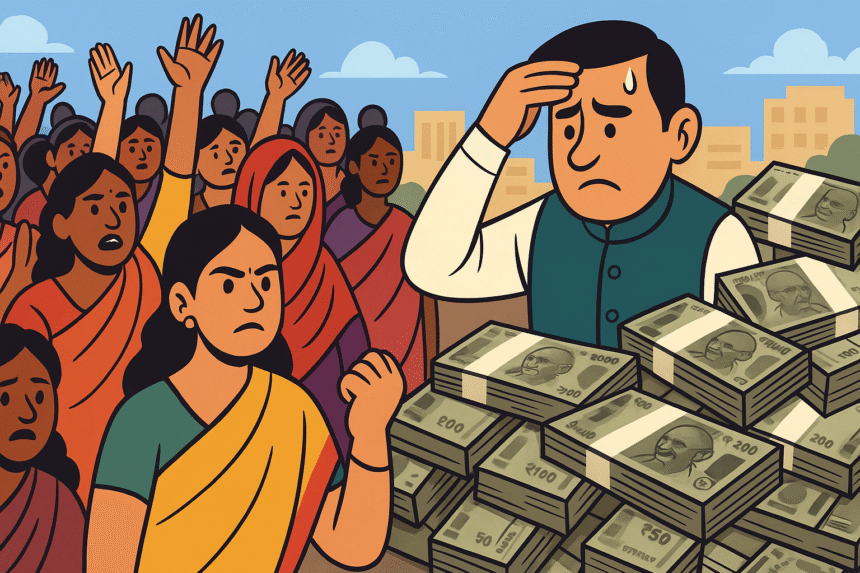
Maharashtra’s Ladki Bahin Yojana is empowering women but shaking state finances. Here’s why this ambitious scheme is now straining other welfare plans.
- 📜 A quick rewind: What exactly is Ladki Bahin Yojana?
- 💰 The price tag that made headlines
- 🏛️ How other schemes are feeling the pinch
- 📉 The bigger financial picture — not so rosy
- ⚖️ Welfare vs. sustainability — the eternal tug of war
- 🔥 Political reactions — applause and alarm
- 🧩 How it affects ordinary people
- 🧐 Lessons for the future
- 💬 The bottom line
- 🔗 Suggested related post
What happens when a well-meaning gift for sisters ends up making the state wallet go ouch? Welcome to the curious case of the Ladki Bahin Yojana — Maharashtra’s ambitious social scheme that started with cheers but is now giving the government sleepless nights.
When generosity meets limited funds, the calculator starts crying.
📜 A quick rewind: What exactly is Ladki Bahin Yojana?
The Ladki Bahin Yojana, officially called Mukhya Mantri Maajhi Ladki Bahin Yojana, was introduced by the Maharashtra government with a clear, heartwarming purpose — to empower eligible women by offering them direct monthly financial help. Each beneficiary woman receives ₹1,500 per month, giving her a little extra control over household expenses, education, health, and personal needs.
Launched before the state assembly elections, the scheme was seen as a political masterstroke — a way to reach out directly to women voters, especially in semi-urban and rural areas. The government had even promised to increase the assistance to ₹2,100 per month, a promise that sounded exciting but, as we now know, is financially heavy to deliver.
💰 The price tag that made headlines
According to Maharashtra’s Food and Civil Supplies Minister Chhagan Bhujbal, who recently broke his silence on the issue, the scheme is costing the state a massive ₹40,000 to ₹45,000 crore annually. Yes, you read that right — that’s a number with so many zeros it could make an accountant faint.
Bhujbal candidly admitted that this single welfare program is now eating into the funds meant for other crucial government schemes. In simpler terms: if one scheme is the main course, there’s hardly any money left for appetizers or dessert.
This is the first time a senior minister from the current government has openly said that Ladki Bahin Yojana is stretching Maharashtra’s finances thin. The revelation has triggered a political storm and heated debates about whether the state can afford to keep the plan running without sacrificing other welfare commitments.
🏛️ How other schemes are feeling the pinch
- Aanandacha Shidha Yojana — a festive sigh
This scheme, launched during Diwali 2022, aimed to provide essential food packages to 1.6 crore families at just ₹100 per kit. The idea was to give affordable festive cheer — flour, oil, sugar, pulses — all packed neatly for the underprivileged.
But Bhujbal now says it’s tough to sustain because ₹500 crore per year is needed to keep it alive. When so much money flows into Ladki Bahin Yojana, Aanandacha Shidha is left gasping for funds. - Shiv Bhojan Thali — struggling to stay on plates
The Shiv Bhojan Thali is a popular meal plan where the needy get a full meal — two chapatis, a sabzi, dal, and rice — for just ₹10. The real cost? Around ₹35 in rural areas and ₹50 in cities, with the government covering the gap.
But here’s the problem: it needs ₹140 crore annually to run smoothly, yet only ₹70 crore is being allocated. The result? The future of this much-loved affordable thali is looking uncertain. - Other welfare initiatives on shaky ground
Departments across the state are reportedly facing budget crunches. Promises made during election campaigns — like raising the monthly Ladki Bahin allowance from ₹1,500 to ₹2,100 — are on hold because, quite frankly, the piggy bank is running dry.
📉 The bigger financial picture — not so rosy
The financial math isn’t smiling either. According to the 2025-26 budget data, Maharashtra’s revenue deficit has touched a whopping ₹45,890.86 crore, more than double the previous year’s estimated deficit of ₹20,050.69 crore. The fiscal deficit? A jaw-dropping ₹1,36,234.62 crore.
In plain English: the state is spending much more than it’s earning, and big-ticket welfare schemes like Ladki Bahin Yojana are one major reason the cash flow is struggling.
Even authoritative reports on India’s state finances have warned that freebie-heavy budgets can lead to long-term stress if not balanced with revenue growth. Maharashtra seems to be experiencing exactly that tension.
⚖️ Welfare vs. sustainability — the eternal tug of war
The Ladki Bahin Yojana shows a classic governance dilemma:
- Social support is essential — women empowerment matters.
- But spending tens of thousands of crores without a clear long-term funding plan is like running a marathon on a single water bottle.
Many economists say schemes like this should be targeted and gradually expanded, rather than rolled out with massive promises before revenue strategies are secured. Others argue that investing in women creates ripple benefits — healthier families, better education, and economic participation — which might pay off in the long run.
Still, the immediate budgetary crunch cannot be ignored. If other schemes — food, education, or job creation — start shrinking, the overall welfare ecosystem could weaken.
🔥 Political reactions — applause and alarm
Politically, this revelation has sparked mixed responses:
- Supporters say the Ladki Bahin Yojana was a bold step for women’s dignity and independence, and cutting it now would hurt lakhs of families.
- Critics argue the government launched it without proper fiscal planning, turning a goodwill project into a financial headache.
- Opposition parties are now using the budget shortfall to question the ruling alliance’s economic management skills.
The debate is fiery, but one thing is clear: big-hearted welfare schemes need equally big-hearted funding plans.
🧩 How it affects ordinary people
For beneficiaries, the scheme is a lifeline — ₹1,500 a month can mean school fees paid on time, better nutrition, or relief from small debts. But if the state cuts back on other subsidies — like cheap meals or festival rations — the same families could feel the pinch elsewhere.
For taxpayers and future generations, there’s a growing worry: where will the money come from? If borrowing increases, it could mean higher debt for the state, and eventually, new taxes or cuts in development projects.
🧐 Lessons for the future
- Welfare needs math, not just emotion
Launching schemes without detailed funding blueprints can create long-term imbalances. - Balance is key
One massive program should not choke smaller but equally vital initiatives. - Transparency wins trust
Admitting financial stress, as Bhujbal did, is a positive step. Honest dialogue helps build better policies. - Invest in empowerment, but wisely
Financial support is great, but pairing it with skills training and income opportunities could make schemes sustainable.
💬 The bottom line
The Ladki Bahin Yojana started as a symbol of care and empowerment for Maharashtra’s women. But today, it’s also a reminder that good intentions need good economics. The state faces a tough question: how to keep promises to women while ensuring other vital programs don’t collapse under the weight of one giant plan.
If Maharashtra can innovate — perhaps by boosting revenue, optimizing spending, or redesigning benefits — it could still save the dream behind this scheme. But for now, the numbers are making even seasoned ministers sweat.
What’s your take? Should governments keep ambitious welfare schemes even if budgets strain, or rethink them for sustainability?
💬 Drop your thoughts below.
🔁 Share this with friends who love discussing politics and public policy.
📲 Stay tuned to Nokjhok for more witty, insightful takes on the news that matters.
🔗 Suggested related post
“Karnataka’s Freebies vs Finances: CAG Raises Alarm”