





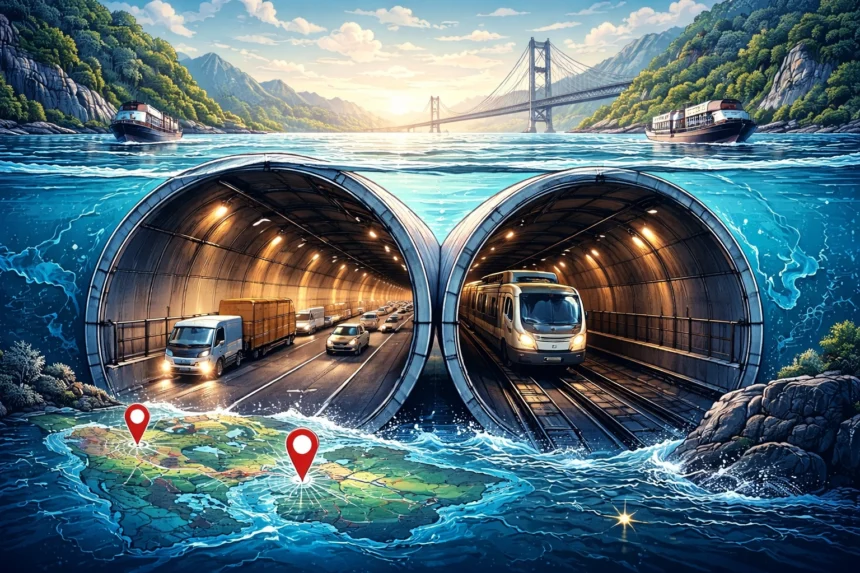
India underwater tunnel project could reshape Northeast connectivity and security—here’s the shocking truth most people are missing.
- Hold your chai for a second ☕—because this is not your usual “road project” news.
- 🧠 What Is the India Underwater Tunnel Project?
- 🤯 Why Everyone Is Suddenly Talking About It
- ⚠️ The Real Reason: China & Bangladesh Factor
- 🚀 What Makes This Project So Powerful
- 🧩 The Hidden Layer: Underground Rail Plan
- 🧪 “This Sounds Crazy, But…” – The Engineering Reality
- 📊 What Experts Are Quietly Saying
- 😏 The Nokjhok Truth (Let’s Be Honest)
- 🌍 What This Means For You (Yes, You)
- 🔮 What Happens Next?
- ❓ FAQs (Featured Snippet Style)
- 1. What is the India underwater tunnel project?
- 2. Why is the Siliguri Corridor important?
- 3. How long is the underwater tunnel?
- 4. What benefits will this project bring?
- 5. Is this project related to China tensions?
- 6. When will the project be completed?
- 📢 Final Thought (Don’t Ignore This)
- 🔗 Related Post (Nokjhok Pick)
Hold your chai for a second ☕—because this is not your usual “road project” news.
Something BIG is quietly brewing under the water… literally.
India is planning an underwater tunnel project so strategic, it might just make China and Bangladesh rethink their next move.
And here’s the kicker:
👉 This isn’t just about roads—it’s about power, control, and speed.
Yes, the India underwater tunnel project is not just engineering. It’s geopolitics with concrete.
Let’s decode what’s really happening (and why most people are missing the real story).
🧠 What Is the India Underwater Tunnel Project?
Let’s simplify it—no engineering degree required.
India is building a twin tube underwater tunnel under the Brahmaputra River in Assam.
- Total length: ~33.7 km
- Tunnel stretch underwater: ~15.7 km
- Type: Road + Rail combined
- Lanes: 4-lane highway
👉 It will connect Gohpur (north bank) to Numaligarh (south bank).
Translation: What earlier took hours (or even half a day), could soon take minutes.
According to infrastructure insights and reports, such mega tunnel projects improve logistics efficiency by up to 30–40% in similar global cases.
For reference, you can explore similar infrastructure concepts explained by
Investopedia’s infrastructure guide.
🤯 Why Everyone Is Suddenly Talking About It
Because this isn’t just a tunnel.
It’s about the Siliguri Corridor—aka India’s “Chicken Neck.”
🐔 What is Chicken Neck?
- Just 22 km wide
- Connects entire Northeast India to the mainland
- Surrounded by Nepal, Bhutan, Bangladesh—and close to China
👉 One disruption here = Northeast cut off.
That’s why experts call it India’s most sensitive geopolitical hotspot.
And here’s the strange part…
India is now building multiple layers of connectivity around it—roads, tunnels, rail, and even military infrastructure.
⚠️ The Real Reason: China & Bangladesh Factor
Let’s not sugarcoat it.
Recent developments:
- China increasing activity near borders
- Bangladesh showing shifting diplomatic signals
- Past tensions like Doklam (2017)
👉 India is clearly saying: “Not today.”
This underwater tunnel project is part of a bigger strategic shield.
Insider Insight:
What experts are noticing is that India is moving from reactive to proactive infrastructure strategy.
Meaning:
Earlier → Build after crisis
Now → Build before crisis
That’s a massive shift.
🚀 What Makes This Project So Powerful
1. Speed = Power
Travel distance could drop from 240 km to just ~34 km in certain routes.
👉 That’s not improvement—that’s a teleportation upgrade.
2. Military Advantage
- Faster troop movement
- Quick logistics
- All-weather connectivity
In defense terms, this is called “response time reduction.”
And guess what?
Even a 10–15% faster response time can change outcomes in border scenarios.
3. Economic Boost
- Better trade routes
- Lower transport cost
- Faster goods delivery
This means:
👉 More jobs
👉 More investment
👉 More growth in Northeast
🧩 The Hidden Layer: Underground Rail Plan
Here’s something most people missed.
India is ALSO planning:
- Underground rail line (~35.7 km)
- Connecting Bagdogra to Siliguri
- Near Air Force stations
👉 Civil + military dual-use infrastructure.
Smart move? Very.
Because modern infrastructure today is not just about civilians—it’s about strategic flexibility.
🧪 “This Sounds Crazy, But…” – The Engineering Reality
Building a tunnel under a massive river like Brahmaputra is not easy.
Challenges include:
- High water pressure
- Soil instability
- Flood risks
- Earthquake sensitivity (Assam is seismic zone)
Yet, India is pushing forward.
Why?
Because globally, underwater tunnels like:
- Channel Tunnel (UK-France)
- Tokyo Bay Aqua-Line
have proven that such projects are not just possible—but transformational.
📊 What Experts Are Quietly Saying
According to infrastructure analysts:
- India is entering a “decade of mega projects”
- Border infrastructure spending has increased significantly in recent years
- Focus is shifting toward multi-layer connectivity (road + rail + defense)
👉 Translation: India is playing the long game.
😏 The Nokjhok Truth (Let’s Be Honest)
Most people think this is just another “sarkari project.”
But the truth?
👉 This is a power move disguised as development.
And here’s the punchline:
“Roads are the new weapons—just without the noise.”
🌍 What This Means For You (Yes, You)
Even if you’re sitting far from Assam, this matters.
Because:
- Strong infrastructure = stronger economy
- Better connectivity = more opportunities
- Secure borders = stable growth
👉 In simple terms: Your future salary might depend on projects like this (no joke).
🔮 What Happens Next?
If executed well:
- Northeast could become a major economic hub
- Travel time could drop drastically
- India’s border control becomes stronger
But if delayed?
Well… we’ve seen that story before.
❓ FAQs (Featured Snippet Style)
1. What is the India underwater tunnel project?
It is a twin tube road-cum-rail tunnel under the Brahmaputra River in Assam to improve connectivity and security.
2. Why is the Siliguri Corridor important?
It is the narrow link connecting Northeast India to the mainland, making it strategically critical.
3. How long is the underwater tunnel?
The project is about 33.7 km long, with around 15.7 km underwater.
4. What benefits will this project bring?
Faster travel, improved trade, military advantages, and economic growth in Northeast India.
5. Is this project related to China tensions?
Indirectly yes—it’s part of strengthening infrastructure near sensitive border areas.
6. When will the project be completed?
Official timelines are evolving, but approvals and planning are already underway.
📢 Final Thought (Don’t Ignore This)
This is not just a tunnel.
It’s a signal.
A signal that India is quietly rewriting its infrastructure playbook—and most people don’t even realize it yet.
👉 So before this becomes tomorrow’s “breaking debate” on TV…
Drop your thoughts in comments. Share this with that one friend who thinks geopolitics is boring.
Because trust me—this one isn’t.
🔗 Related Post (Nokjhok Pick)
“India Nuclear Energy: The Move That Shook Everyone”
Credit: NBT